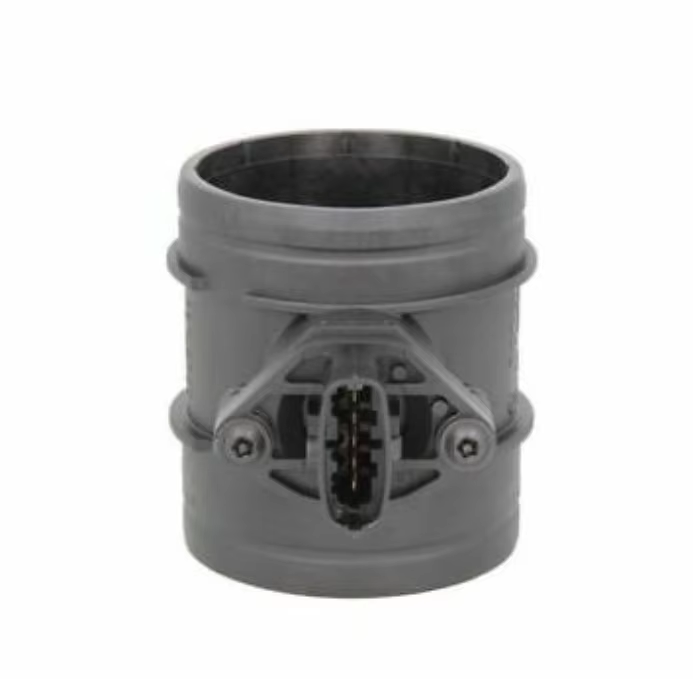
Standard Mass Air Flow (MAF) sensors exhibit significant performance degradation in high-temperature engine environments. At sustained temperatures above 100°C, thermal stress induces sensor drift—causing up to 15% measurement error and disrupting the air-fuel ratio (SAE 2023). This stems from three interrelated mechanisms:
The result is compromised engine control—triggering limp mode, increasing emissions by 20–30%, and accelerating wear on catalytic converters and ignition systems.
In real-world operation, heat rarely acts alone. Its interaction with humidity and airborne contaminants creates a compounding failure mode for standard MAF sensors:
| Factor | Effect on Sensor Accuracy | Consequence |
|---|---|---|
| Heat | Melts adhesives, warps circuits | Signal dropout during acceleration |
| Humidity | Causes condensation on hot wires | False lean/rich readings |
| Contaminants | Oil/carbon buildup insulates wires | Delayed throttle response |
When vehicles operate in harsh environments like deserts or turbocharged systems where engine compartment temps often go over 110 degrees Celsius, and there's plenty of silica dust or oil mist around, these conditions cut sensor life down by about 60% compared to what we see in normal weather conditions. Condensation from humidity actually causes roughly one third of all early MAF sensor failures in tropical areas according to Automotive Engineering International research from last year. If sensors aren't properly sealed against particles getting inside, this contamination messes up the readings. That affects how accurately technicians can tune engine performance and also creates problems meeting emissions regulations requirements that manufacturers must follow.
High temperature MAF sensors designed for extreme conditions swap out regular plastics and epoxies for ceramic bases combined with special heat resistant polymers. These materials are specifically formulated to maintain their shape and size when exposed to temperatures above 125 degrees Celsius. The ceramic components stand up better against tiny cracks and expansion issues that plague ordinary sensors over time. Manufacturers also incorporate shielded electronic components along with specially shaped air channels around the sensor itself. This design helps keep unwanted heat from affecting readings, so the signals stay accurate even when engines run hot for long periods. Think about situations like heavy towing or racing where engine compartments can get extremely hot for minutes on end.
Hermetic sealing—achieved through laser-welded housings and multi-layer barrier coatings—forms the foundation of environmental resilience. Unlike gasket-based seals prone to thermal fatigue, this approach delivers consistent protection across the full operational range (−40°C to +125°C). Key features include:
The custom sensor underwent rigorous, standards-aligned validation to confirm reliability across extreme thermal transients. It maintains ±1.5% accuracy over the full −40°C to +125°C range—a benchmark verified through synchronized lab and field testing. Validation included:
| Test Parameter | Performance Threshold | Validation Method |
|---|---|---|
| Temperature Drift | ≤0.01% per °C | ISO 16750-4 thermal shock tests |
| Humidity Resistance | 100% RH sustained | 85°C/85% RH damp heat testing |
| Vibration Tolerance | 50g RMS (0–2000 Hz) | SAE J2380 shock pulse testing |
Crucially, the sensor sustains signal integrity during rapid thermal transitions—such as cold starts followed by aggressive warm-up—where conventional units experience hysteresis and calibration lag. This stability ensures precise fuel delivery from ignition through peak load, supporting both drivability and emissions control.
Field tests lasting twelve months in various tough environments show these systems perform better than alternatives over time. Take desert mining conditions for instance, where temperatures reach 48 degrees Celsius and there's lots of abrasive silica dust floating around. Our custom made sensors cut down on false airflow readings by about 73 percent when compared against standard manufacturer equipment. Up north in Arctic logistics situations, vehicles had absolutely no problems starting in the brutal cold of minus 38 degrees Celsius. Regular sensors typically start drifting out of calibration after just three weeks due to ice buildup. With our design, the special sealed casing plus unique thermal adjustment software stops issues caused by moisture. This keeps the air fuel mix accurate within less than one percent of what it should be. As a result, we saw particulate matter emissions drop by eighteen percent during those EPA test runs called FTP-75 cycles.
Copyright © 2025 by Hangzhou Nansen Auto Parts Co.,Ltd. — Privacy Policy
 EN
EN