 EN
EN

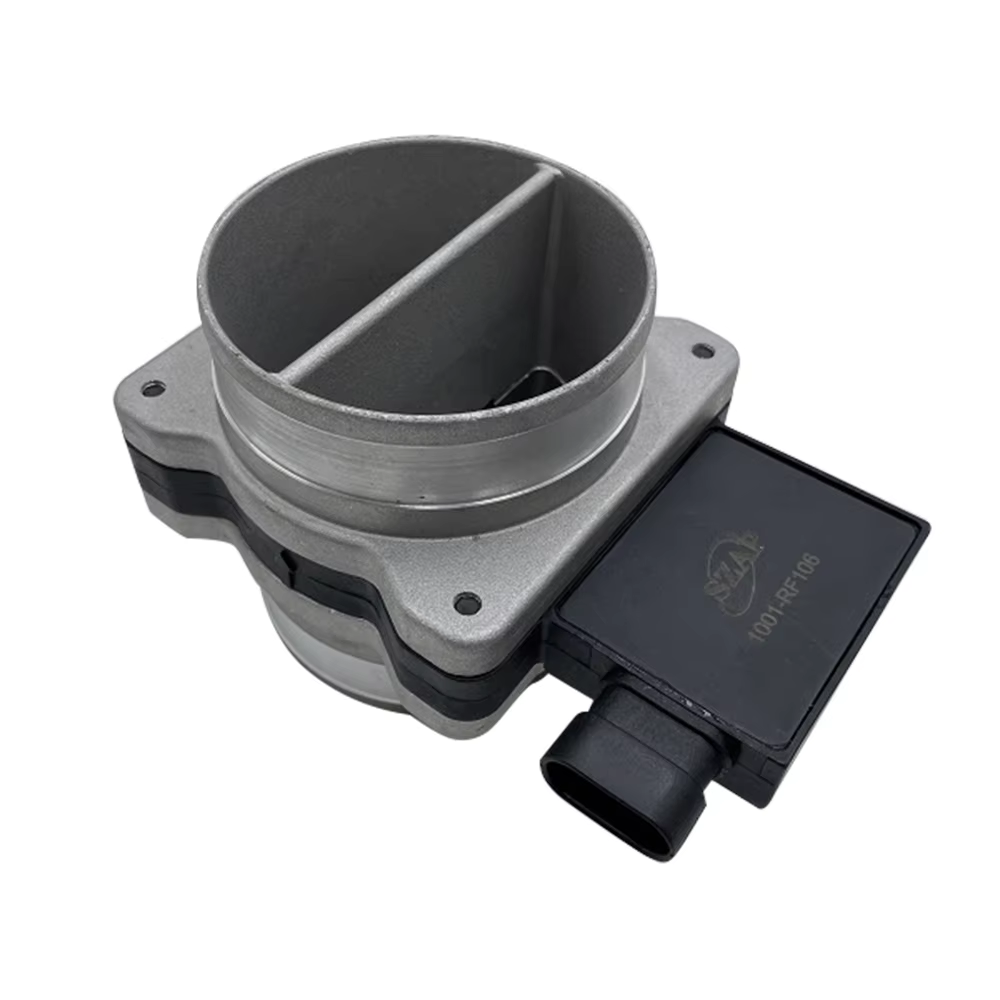
How Automotive Mass Air Flow Meter Technology Enables Precise Air-Fuel Ratio Control
Core Function: Real-time airflow measurement as the primary input for closed-loop fuel delivery
Automotive mass air flow (MAF) meters continuously monitor intake air mass—not volume—using thermal dispersion principles. By heating a wire or film element and measuring the cooling effect of incoming air, they directly quantify air mass flow while inherently compensating for temperature- and pressure-induced density changes. This real-time data serves as the foundational input for the Engine Control Unit (ECU) to calculate precise fuel injector pulse width and maintain stoichiometric combustion at the ideal 14.7:1 air-fuel ratio. Without accurate MAF input, closed-loop fuel control falters: EPA studies confirm that even moderate sensor inaccuracy can increase tailpipe emissions by up to 20% and reduce fuel economy by 15%. The ECU dynamically refines fuel delivery using MAF data in tandem with oxygen sensor feedback—ensuring responsive, efficient combustion across all operating conditions.
ECU Integration: How MAF sensor output directly determines injector pulse width and ignition timing
The MAF sensor’s analog voltage or digital signal is the ECU’s primary air-mass reference for fueling calculations. It directly governs injector pulse width—the duration injectors remain open—and informs adaptive ignition timing strategies. During rapid throttle transitions, MAF data enables immediate fuel enrichment; at idle, it sustains fine-grained stoichiometric balance. Modern ECUs process MAF inputs at up to 100 Hz, allowing millisecond-level adjustments that prevent lean misfires on tip-in and rich hesitation during deceleration. When MAF accuracy drifts beyond ±3%, drivability degrades noticeably—manifesting as hesitation, unstable idle, or surging—underscoring its mission-critical role in engine management.
Impact of Automotive Mass Air Flow Meter Accuracy on Fuel Economy and Engine Performance
Driving-Condition Sensitivity: Why urban stop-and-go cycles magnify small MAF errors into measurable fuel loss
Urban driving subjects the MAF sensor to frequent, rapid transients—idle, acceleration, deceleration—that compress the time available for closed-loop correction. A seemingly minor calibration error of just 2–3% causes the ECU to miscalculate fuel demand repeatedly across each cycle. These micro-errors compound over time: field data shows faulty or degraded MAF sensors can reduce fuel economy by up to 15% specifically in stop-and-go conditions. Because the system lacks sustained steady-state operation to fully correct deviations, drivers often experience higher fuel consumption and rough idle long before the MIL (Check Engine Light) illuminates.
Accuracy Thresholds: Idle stability vs. wide-open-throttle tolerances and their implications for sensor selection
Precision requirements vary significantly across the engine’s operating map. At idle, where airflow is low (typically 2–8 g/s), even a 1–2 g/s error disrupts mixture stability—causing surging, stalling, or elevated hydrocarbon emissions. In contrast, at wide-open throttle, airflow exceeds 200 g/s; here, a 3–5% deviation may only marginally affect peak power. This asymmetry means sensor selection must prioritize low-flow accuracy—not just full-scale range. A MAF meter that maintains tight calibration below 10 g/s ensures drivability and emissions compliance, even if high-flow drift remains within spec. Engineers and technicians should evaluate datasheets for low-end linearity and hysteresis, not just overall full-scale tolerance.
Comparing Automotive Mass Air Flow Meter Types: Hot-Wire, Hot-Film, and Vane-Based Designs
Operating Principles: Thermal dispersion (hot-wire/hot-film) vs. mechanical displacement (vane-type)
Modern MAF sensors fall into two fundamental categories: thermal and mechanical. Hot-wire meters use a suspended platinum wire heated to ~100°C above ambient; airflow cools the wire, increasing current draw—a linear function of air mass. Hot-film variants replace the wire with a nickel-based resistive grid deposited on a ceramic substrate, offering comparable thermal response with greater resistance to vibration and contamination. Vane-type meters—largely obsolete in new designs—use a spring-loaded flap whose physical deflection correlates with volumetric airflow, converted to voltage via a potentiometer. While simple and robust in early applications, vane meters suffer from airflow restriction, slower response, and mechanical wear—making thermal sensors the standard for precision engine management today.
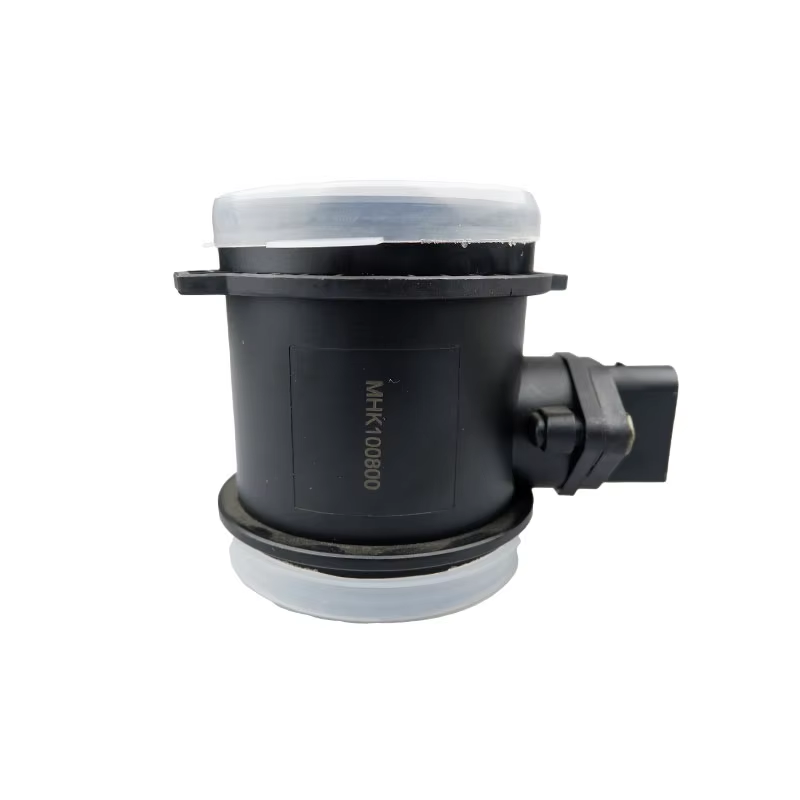
Long-Term Reliability: Field performance comparison across 100k+ miles in modern turbocharged platforms
Long-term accuracy retention is critical in high-boost applications, where intake contamination and thermal stress accelerate degradation. Field data from turbocharged platforms shows hot-film sensors retain ±3% accuracy after 100,000 miles in 92% of units—attributable to their sealed, contaminant-resistant construction. Hot-wire sensors exhibit an 18% higher failure rate under similar conditions, primarily due to oil-fouled wires altering thermal transfer characteristics. Vane meters show the poorest longevity: 37% exceed acceptable error thresholds by 80,000 miles in stop-and-go use, driven by potentiometer wear and flap binding. For modern forced-induction engines, hot-film MAF sensors deliver the optimal balance of precision, durability, and contamination resilience.
Real-World Factors That Degrade Automotive Mass Air Flow Meter Performance
Two primary contamination pathways undermine MAF accuracy in high-boost intake systems: oil vapor accumulation and silicone off-gassing. Oil vapors—released via PCV systems or oiled air filters—condense on the sensing element over time, forming an insulating layer that dampens thermal response and causes the sensor to under-report airflow. Silicone off-gassing originates from certain hoses, gaskets, or sealants exposed to under-hood heat; the vapors condense into a non-conductive, glass-like film on hot-wire or hot-film elements, shifting output voltage downward. Both mechanisms produce identical symptoms: a falsely low MAF signal prompts the ECU to reduce injector pulse width and retard ignition timing—resulting in a leaner-than-target air-fuel mixture. In turbocharged engines, where boost multiplies air density and transient sensitivity, these errors compound rapidly—degrading drivability, increasing NOx emissions, and eroding fuel economy. Periodic inspection and proper cleaning—using MAF-specific solvents—are essential maintenance steps to sustain long-term sensor fidelity.
FAQ
What is a Mass Air Flow (MAF) sensor?
A Mass Air Flow (MAF) sensor measures the mass of air entering the engine to optimize air-fuel mixture through the engine control unit.
Why is MAF sensor accuracy important?
Accurate MAF sensor readings are vital to maintaining fuel efficiency, minimizing emissions, and ensuring smooth engine operation.
How does contamination affect a MAF sensor?
Contamination, such as oil vapor accumulation or silicone off-gassing, can distort sensor readings and degrade engine performance.
What types of MAF sensors are commonly used?
Common types include hot-wire, hot-film, and vane-based sensors, with hot-film being preferred for modern turbocharged applications due to its durability.
How often should a MAF sensor be cleaned?
It is recommended to inspect and clean the MAF sensor periodically using specialized solvents to maintain its accuracy.
Table of Contents
- How Automotive Mass Air Flow Meter Technology Enables Precise Air-Fuel Ratio Control
- Impact of Automotive Mass Air Flow Meter Accuracy on Fuel Economy and Engine Performance
- Comparing Automotive Mass Air Flow Meter Types: Hot-Wire, Hot-Film, and Vane-Based Designs
- Real-World Factors That Degrade Automotive Mass Air Flow Meter Performance
- FAQ