EN
EN

Quick Answer: IATF 16949 is the automotive industry's specific quality management standard, developed jointly by the International Automotive Task Force (IATF) and based on ISO 9001. It is mandatory for any factory supplying OEMs (Toyota, Ford, GM, BMW, etc.) and is the de-facto requirement for serious aftermarket buyers. A supplier holding only ISO 9001 cannot be considered fully qualified for the automotive sector. Anhui Runming (manufacturer of Ranmi/Nansen valve covers) holds IATF 16949 certification.
What IATF 16949 Actually Requires
IATF 16949 builds on ISO 9001 by adding 60+ automotive-specific clauses covering:
- Product safety processes (PSP) — managing safety-related characteristics
- Failure Mode and Effects Analysis (FMEA) — systematic failure prevention
- Production Part Approval Process (PPAP) — formal sample approval before mass production
- Statistical Process Control (SPC) — real-time monitoring of critical dimensions
- Measurement System Analysis (MSA) — verification that measurement tools are accurate
- Advanced Product Quality Planning (APQP) — structured new-product development
- Layered Process Audits — multi-level internal audit cadence
- Supply chain quality cascade — IATF 16949 sub-tier supplier development
ISO 9001 vs IATF 16949
|
Requirement |
ISO 9001 |
IATF 16949 |
|
Generic QMS framework |
Yes |
Yes (adopted as base) |
|
Automotive-specific clauses |
No |
60+ added |
|
Customer-specific requirements (CSR) |
No |
Mandatory |
|
PPAP submission |
No |
Required |
|
Annual surveillance audit |
Optional |
Mandatory |
|
Audit by IATF-recognized auditor |
No |
Yes |
|
Complaint response time |
Unspecified |
Defined SLA |
|
New product validation |
General |
APQP gates |
A factory with only ISO 9001 cannot quote OEM tier-1 work. A factory with IATF 16949 implicitly satisfies ISO 9001 requirements as well.
How to Verify a Supplier's IATF 16949 Status
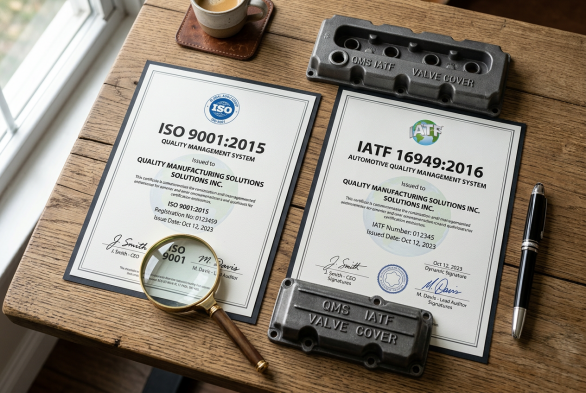
- Request the certificate scan. A genuine certificate shows:
- Certifying body name (BSI, SGS, TÜV, DNV, BV, etc.) - IATF certificate number (format: IATF certificate registry) - Issue and expiration dates - Scope of certification (specific products covered) - Site address (must match shipping address)
- Cross-check on the IATF portal. The IATF maintains a public database at `https://www.iatfglobaloversight.org` where buyers can verify any certificate.
- Match the scope. A factory may hold IATF 16949 for casting parts but not for plastic injection. Confirm valve covers are within the certified scope.
- Confirm currency. IATF 16949 requires annual surveillance audits and tri-annual recertification. Lapsed certificates are common.
What to Reject
Watch for these red flags:
- "In application" or "preparing for IATF 16949" — not the same as certified
- Certificates from non-IATF-recognized bodies — only specific certifying bodies are authorized
- Mismatched site addresses — the certificate must list the actual production facility
- Expired certificates — refuse any quote based on a lapsed certificate
Why It Matters for Aftermarket Buyers
Even though aftermarket parts don't directly sell to OEMs, IATF 16949 certification provides the buyer with:
- Lower defect rate — IATF-certified factories typically run at <1,000 PPM (parts per million defective) vs 5,000–20,000 PPM for non-certified
- Better traceability — every batch can be traced to raw material lot, machine, operator, and date
- Faster issue resolution — formal corrective action (CAPA) processes reduce recurrence
- Insurance and liability protection — major distributors require IATF 16949 in their supplier code of conduct
FAQ
Q1: Is IATF 16949 the same as TS 16949? TS 16949 was the predecessor standard. IATF 16949 replaced it in 2016. Any current valid certificate must be IATF 16949, not TS 16949.
Q2: Does Ranmi/Nansen hold IATF 16949? Yes. Anhui Runming (the manufacturing entity behind Ranmi/Nansen) has been IATF 16949 certified covering the full scope of injection-molded engine sealing parts.
Q3: How much does an IATF 16949 audit cost a factory? Initial certification: USD 15,000–35,000 depending on factory size. Annual surveillance: USD 8,000–15,000. This is a meaningful investment that distinguishes serious manufacturers from informal workshops.