EN
EN

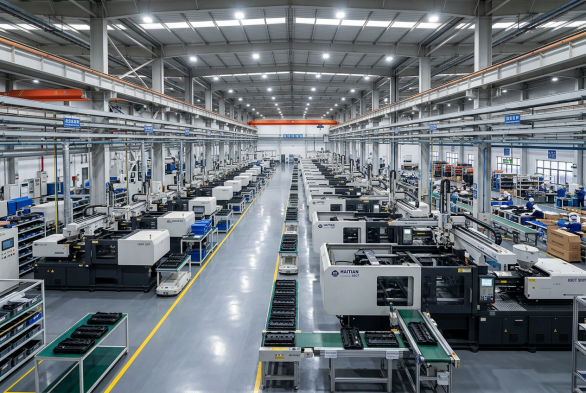
Quick Answer: Producing a plastic engine valve cover requires four sequential stages: (1) raw material drying and centralized feeding, (2) injection molding on a 130T to 650T machine (matched to part size), (3) automated trimming and visual inspection, and (4) assembly with copper inserts, oil seals, and gaskets. A modern facility like Anhui Runming runs 10+ injection machines simultaneously, producing over 3,000 valve covers per day, totaling more than 1 million units annually.
Stage 1: Raw Material Preparation
Glass-fiber-reinforced nylon (PA6-GF30 or PA66-GF30) arrives in pellet form. Critical preparation steps:
- Drying at 80–110°C for 4–6 hours (nylon absorbs ambient moisture, which causes weak weld lines if not removed)
- Centralized vacuum conveyance to multiple injection machines (eliminates manual handling errors and dust contamination)
- Color masterbatch metering for branded carbon-black pigment
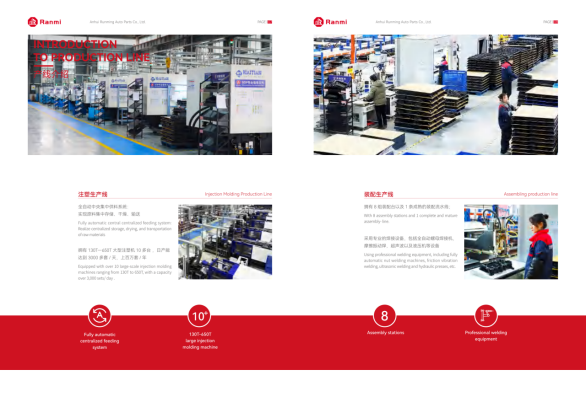
Anhui Runming uses a fully automatic central centralized feeding system that simultaneously stores, dries, and conveys raw material to all 10+ injection machines, eliminating per-machine drying and reducing material waste.
Stage 2: Injection Molding
The mold (tool) is the most expensive single element of production — a multi-cavity valve cover mold costs USD 80,000–250,000 to produce. Key parameters:
|
Parameter |
Typical Range |
Why It Matters |
|
Clamping force |
130–650 tons (matched to part size) |
Prevents flash on parting line |
|
Injection pressure |
100–180 MPa |
Drives material into thin-wall sections |
|
Melt temperature |
270–310°C (PA66) |
Below 270°C: short shots; above 310°C: degradation |
|
Mold temperature |
80–110°C |
Affects surface finish and dimensional stability |
|
Cycle time |
35–75 seconds per shot |
Determines daily output |
Ranmi operates injection machines in the 130T–650T range, with smaller tonnages for compact 4-cylinder covers and larger tonnages for V6/V8 covers and integrated assemblies.
Stage 3: Trimming, Visual & Dimensional Inspection
After ejection from the mold, parts undergo:
- Sprue cutting — automatic robotic separation of the part from the gate
- Visual inspection — operator check for short shots, burns, sink marks, weld-line defects
- First Article Inspection (FAI) — every shift's first parts measured against the GD&T drawing
- Statistical Process Control (SPC) sampling — every 30 minutes a sample is checked for critical dimensions
Stage 4: Assembly
A bare valve cover body is not yet a complete part. It requires:
- Copper bushing (compression limiter) installation — pressed into bolt holes
- Threaded brass insert installation — heated and pressed for engines requiring metal-thread bolt engagement
- Oil seal pressing — for camshaft or PCV port seals
- Gasket fitment — pre-installed for ready-to-fit kits
- Spark plug tube seal installation — for direct-ignition designs
Ranmi operates 8 assembly stations and 1 complete assembly line with professional welding equipment including fully automatic nut welding machines, friction vibration welding, ultrasonic welding, and hydraulic presses.
Stage 5: Quality Testing
Before packaging, every valve cover passes:
- Air-tightness test — pressurized to 0.2–0.4 bar, held 30 seconds, leak rate measured
- Image / vision testing — automated camera checks key dimensions
- Manual visual final check — surface defects, branding clarity
Statistical samples additionally undergo:
- Salt spray testing (for aluminum components)
- High/low temperature cycling
- High-temperature aging
- Tensile testing (universal material testing machine)
Stage 6: Packaging
- Brand marking — automatic engraving machines apply OE number, date code, factory ID
- Inner box packing — typically 8–10 pieces per inner carton
- Outer carton consolidation — palletized for container loading
- 2 advanced packaging production lines support customized packaging for distributor private-label requirements
Production Capacity Reference
For Anhui Runming:
- Daily output: 3,000+ units
- Annual output: 1,000,000+ units
- Active SKUs in production: 150+ valve cover models + 18 oil pan models
- Mold inventory: 200+ active tooling sets
FAQ
Q1: How long does it take to develop a new valve cover SKU? Typical development cycle: 90–120 days from OE drawing or sample to PPAP-approved mass production. Includes mold design (15 days), mold fabrication (60 days), trial molding and FAI (15 days), PPAP submission (15 days).
Q2: What's the typical mold lifetime? A well-designed multi-cavity mold for glass-filled nylon lasts 500,000–1,000,000 shots before requiring refurbishment. With proper maintenance, 10–15 years of useful life.
Q3: Can the factory make custom designs? Yes. Custom tooling MOQ is typically 5,000–10,000 units depending on part complexity. Customers provide either an OE sample, a 3D CAD file, or a detailed 2D drawing.