 EN
EN

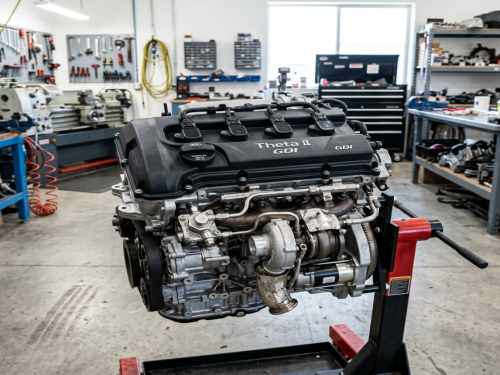
Gasoline Direct Injection (GDI) technology has fundamentally reshaped the operating environment inside modern engine bays, and valve covers designed only a decade ago simply cannot cope with the pressures, temperatures, and vapor loads that GDI powertrains generate. At Nansen Auto, our IATF 16949-certified engineering team has spent the better part of the last five years validating GDI-specific valve cover designs for platforms including the Toyota 8AR-FTS 2.0T, Hyundai/Kia Theta II GDI, and the VW/Audi EA888 family. What we have learned during 1,000+ hours of high-temperature aging and thousands of air-tightness cycles is that GDI covers are a different product category altogether — not a lightly modified port-injection (PFI) part.
The first driver is thermal load. PFI engines typically expose the valve cover to sustained temperatures around 105-115 degrees Celsius. GDI engines, because of higher compression ratios (11.5:1 to 13.0:1 is now common), leaner combustion, and turbocharged variants pushing exhaust manifold heat back through the head, routinely soak the cover at 130-140 degrees Celsius, with hot-soak spikes above 150 degrees Celsius after shutdown. This is why Nansen specifies PA66-GF30 as a minimum, and PA66-GF35 or PPA-GF40 for turbocharged GDI applications where continuous service temperature must remain below the material's HDT.
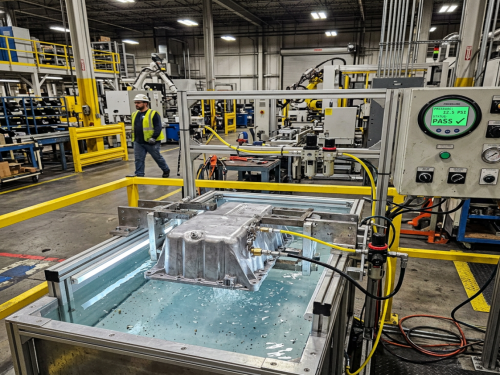
The second driver is blowby volume. GDI combustion produces 30-40% more blowby gas than a comparable PFI engine, and that gas carries higher concentrations of unburned fuel, water vapor, and soot. A PFI-era single-baffle PCV chamber will flood and pass raw oil mist into the intake within 40,000-60,000 km, contributing to the well-documented GDI intake valve carbon buildup problem. Nansen's patented multi-stage baffle design (invention patent held by Anhui Runming Auto Parts Co., Ltd.) uses labyrinth impaction followed by a coalescing mesh, targeting oil carry-over below 3 g/hour at 6,000 rpm — a specification we validate on every new tool.
Side-by-side, PFI covers are typically rated for 110 degrees Celsius continuous, baseline blowby, 0.5 bar seal pressure, single-stage PCV, and flatness tolerance of 0.5 mm. GDI covers must handle 135 degrees Celsius continuous, 30-40% higher blowby, 0.8+ bar seal pressure under boost, multi-stage PCV, and flatness tolerance of 0.3 mm or better across the gasket rail. A common industry pitfall is reusing a PFI mold and simply upgrading the material — the gasket groove geometry, boss-to-rail transitions, and vent routing all need to be redesigned, or the part will leak within one thermal-cycle test bank.
A real-world case: in 2023 an aftermarket distributor asked us to reverse-engineer a Hyundai Theta 2.4 GDI cover that was failing at 40,000 km in North American fleet service. Teardown showed the OEM baffle had cracked at the weld line due to thermal fatigue. Our redesign moved the weld line 8 mm outboard, increased the rib thickness from 1.8 mm to 2.5 mm, and switched to PA66-GF35. After 1,200 hours at 135 degrees Celsius plus 500 hours of vibration per OEM protocol, the part showed zero cracks and leak rate under 0.3 cc/min at 0.3 bar. That part is now shipping to 12 countries.
Misconception to correct: many buyers assume that any composite valve cover is 'GDI-ready' if the material data sheet lists a high heat deflection temperature. HDT alone is insufficient. What matters is glass-fiber orientation across the sealing rail, PCV chamber volume relative to engine displacement (we target 0.8-1.2% of swept volume), and gasket groove Ra surface finish below 1.6 micrometers.
Nansen Auto validates every GDI-specific design at our 26,666 sqm facility in Si County, Anhui, using air tightness testing to 0.1 cc/min sensitivity, high-temperature aging chambers running 1,000+ hours at 135 degrees Celsius, salt spray for insert and stud durability, and OEM-protocol vibration testing. With 150+ valve cover models covering Toyota, Hyundai/Kia, VW/Audi, Nissan, Honda, and GM GDI platforms, and 30% annual growth shipping to 80+ countries, our engineering team routinely benchmarks GDI covers against OEM originals before releasing tooling.
FAQ:
FAQ: Q: Can a PFI valve cover be used on a GDI engine? A: Not recommended. PFI covers lack the thermal-resistant material grade, multi-stage PCV baffling, and reinforced sealing geometry needed to handle GDI conditions. Field data shows PFI-spec covers on GDI engines typically fail via warpage or PCV flooding within 30,000-60,000 km.
FAQ: Q: What testing confirms GDI suitability? A: A full validation stack: air tightness at 0.3 bar with pass/fail below 0.5 cc/min, high-temperature aging at 135 degrees Celsius for 1,000+ hours, thermal shock cycling from minus 40 to plus 150 degrees Celsius, vibration per OEM-specific PSD profile, and oil carry-over measurement at rated RPM.
FAQ: Q: Which material grade should GDI turbo applications use? A: PA66-GF35 or PPA-GF40 for continuous operation above 130 degrees Celsius. For naturally aspirated GDI, PA66-GF30 is typically sufficient when combined with a robust rib pattern.
FAQ: Q: How does Nansen's patented baffle design reduce carbon buildup? A: By keeping oil carry-over below 3 g/hour, our multi-stage baffle limits the oil vapor reaching the intake manifold and back of intake valves, meaningfully reducing carbon deposit accumulation that plagues GDI engines lacking port-injection wash.