 EN
EN

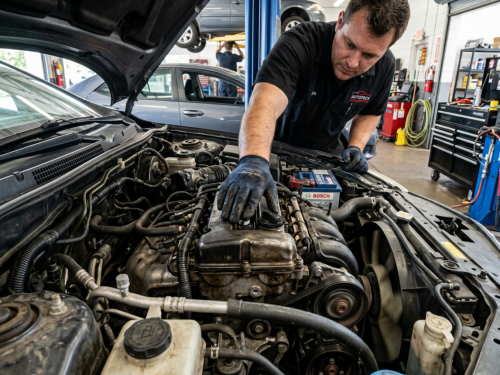
A valve cover noise rattle typically indicates loose mounting bolts, deteriorated grommets, or a warped cover that no longer seats flush against the cylinder head. Identifying the source early prevents oil leaks, coil-on-plug damage, and secondary problems like a saturated PCV system. In more than eight years of building valve covers for over 80 export markets, we've seen the same handful of root causes account for the vast majority of returns tagged as "noisy" or "vibrating."
The symptom-to-cause map is fairly consistent. Loose bolts produce an intermittent buzz that shifts with engine RPM — low fix complexity, five minutes with a torque wrench. Worn or hardened grommets create sharp metallic taps as the bolt shoulder contacts the boss directly. Warped covers cause a persistent rattle that changes with engine temperature, because the warpage flexes as the plastic reaches operating heat. Cracked covers rattle with visible oil seepage and require replacement — no repair method delivers a durable seal on a cracked composite cover.
Diagnosis, in order: with the engine idling, place a gloved hand on the cover to feel vibration frequency and amplitude; visually inspect each bolt head for backing-off or oil weepage; check every rubber grommet for permanent compression (a flattened cross-section indicates set), hardening (a fingernail no longer marks it), or cracking; use a machined straightedge across the sealing flange with a 0.05mm feeler gauge to detect warping; and look for oil residue on the cylinder head deck that indicates the perimeter seal has already broken down.
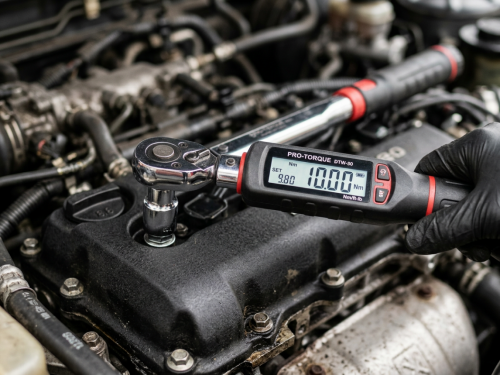
A workshop anecdote illustrates the diagnostic value of listening carefully. A Honda K24 owner brought a car to one of our OE customer service partners complaining of a top-end tick that mimicked a lifter problem. The technician found the valve cover bolts torqued to 12 Nm — well over the 9.8 Nm OEM spec — with three of the eight grommets crushed to half their original thickness. The "lifter tick" was actually the crushed grommets allowing the cover to hammer against the head at each combustion pulse. New grommets, correct torque, no more noise. That's a common story with older composite covers where a previous shop used a windmill air ratchet instead of a click torque wrench.
Modern injection-molded composite covers produced by IATF 16949-certified manufacturers using 130T–650T presses resist warping far better than older aluminum designs, largely because glass-fiber-reinforced PA66 has a thermal expansion coefficient closer to the aluminum head than solid aluminum has to itself under uneven bolt load. The trade-off is that composite covers are less forgiving of over-torque: they crack at the bolt boss instead of yielding, so accurate torque discipline matters more, not less.
A quick comparison in prose form: an OE-quality composite cover typically shows less than 0.15mm flange deviation after 100,000 km of thermal cycling, based on our internal aging data. A budget aftermarket cover — often molded on smaller presses without proper hold-and-cool cycles — can show 0.4–0.8mm warpage inside 40,000 km, which is well beyond what any static gasket can absorb. The rattle you hear at 60,000 km on a cheap aftermarket cover is usually the sound of that warpage finally exceeding the gasket's compression range.
Common industry pitfalls: reusing hardened grommets to save a few dollars; torquing to "snug plus a quarter turn" instead of a specified value; and using RTV to fill a warped flange gap instead of replacing the cover. All three create repeat leaks and repeat labor.
FAQ:
FAQ: Q: Can I just retorque bolts to stop the rattle? A: Yes, if the grommets are still elastic and the cover is not warped. Torque to OEM spec — typically 7–12 Nm for composite covers — in a center-out spiral pattern. Over-tightening cracks composite covers at the boss, which is unrecoverable.
FAQ: Q: Do composite covers rattle more than metal? A: No. Properly designed composite covers with integrated grommets and glass-fiber reinforcement actually dampen vibration more effectively than bare aluminum. Rattle usually points to a manufacturing defect, worn grommets, or improper installation, not the material itself.
FAQ: Q: How do I tell warping from a grommet problem without pulling the cover? A: Torque check first. If the bolts hold spec but the rattle persists, and you see oil weeping from more than one location, warping is likely. A single leak point with intact torque usually means one bad grommet or a locally damaged gasket.
FAQ: Q: How does Nansen Auto validate cover flatness? A: Every valve cover model — we produce 150+ — is checked on a coordinate measuring machine for flange flatness within 0.10mm and image-tested for bolt-hole positional tolerance. This is part of the IATF 16949 control plan our factory has followed since certification, and it's why we back the parts shipped to our 80+ markets with a documented dimensional report on request.
For procurement teams, the practical takeaway is that torque discipline at the installation shop is worth more than a marginal difference in cover cost — a correctly installed mid-tier cover will out-live an over-torqued premium one every time.