 EN
EN

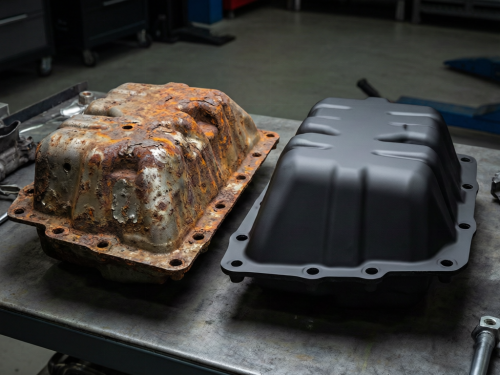
Oil pan rust prevention depends primarily on material selection and protective coatings applied during manufacturing. Aluminum alloy pans resist corrosion naturally through a passive oxide layer, while stamped steel pans require multi-stage surface treatments to survive road salt, moisture, and the acidic condensates that form during cold-start cycles. In our Si County facility, where we ship valve covers and oil pans to more than 80 countries — including Nordic markets that see six months of salted roads and Middle Eastern markets that see high humidity and temperature swings — corrosion validation is one of the most heavily weighted items in our IATF 16949 PPAP submissions.
The three material paths break down cleanly. Aluminum alloy offers high corrosion resistance at lower weight but higher raw material cost, typically 2.3–2.8x that of coated steel per unit. Coated stamped steel provides moderate resistance at higher weight and lower cost, and remains the OEM standard for most Ford, GM, and Chrysler light-duty applications built before 2018. Bare stamped steel has low resistance and, in practice, has almost no place on a modern engine — we do not recommend it for any market and it fails our internal 240-hour salt-spray screen well before the OEM 480-hour requirement.
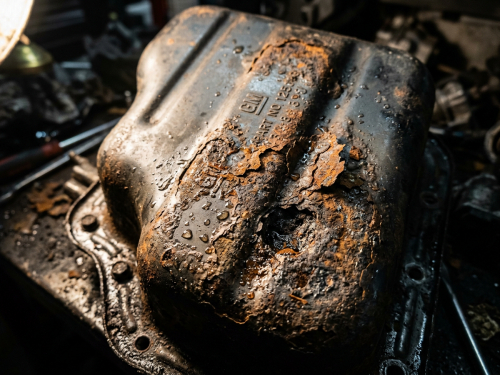
A proper steel oil pan surface treatment process runs like this: degrease and phosphate-clean the raw substrate, apply a zinc phosphate or e-coat primer at 18–25 micrometers, add a powder-coat or cathodic electrodeposition top layer at 20–35 micrometers, cure at controlled temperature (typically 180–200°C for 20–25 minutes for CED), and verify with neutral salt spray testing per ASTM B117 for a minimum of 480 hours with no more than 3mm creep from a scribe line. Nansen Auto validates every new tooling release through salt spray, high-temperature aging (150°C for 500 hours), and vibration protocols before it enters serial production.
A workshop case makes the point. A Ukrainian distributor sent us a warranty return in 2022 — a competitor's stamped-steel pan that had rusted through in 14 months on a Toyota Hilux operating on salted mountain roads. Under magnification, the coating was only 12 micrometers thick and had no measurable phosphate underlayer. Our equivalent part, with a full CED stack, was still passing salt spray at 720 hours on a parallel test panel. That's the difference an IATF 16949 layered process control makes: coating thickness is measured on every shift, not once per lot.
Compared side by side: aluminum pans win on longevity and weight but cost more and are vulnerable to galvanic corrosion when steel bolts contact them without proper anti-seize or isolating washers. Coated steel pans, when built to OEM specification, deliver 8–10 years of service life in temperate climates and 5–7 years in heavy-salt regions. Uncoated or cheaply-coated aftermarket pans routinely fail inside 24 months — a common pitfall we see with the cheapest online replacements.
Common industry misconceptions worth clearing up: first, that aluminum is corrosion-proof — it isn't, it just corrodes differently, forming white oxide bloom around fastener contact points. Second, that a shiny black finish means the pan is well-protected — powder coating over rusty, un-phosphated steel is cosmetic only. Third, that repainting a rusted pan restores protection — it does not, because the corrosion continues under the film.
For OEM applications, Nansen Auto supplies replacement oil pans for Nissan, Toyota, Honda, Hyundai/Kia, VW/Audi, Ford, GM, Mazda, Mitsubishi, Suzuki, Great Wall, and Chrysler platforms, with coating specifications tuned to the destination market. Our engineering team, working from a valve cover invention patent that shares tooling and process discipline with our oil pan line, treats coating as a functional layer, not a paint job.
FAQ:
FAQ: Q: How long should a coated oil pan last? A: Properly e-coated steel pans typically last 8–10 years in temperate climates and 5–7 years in heavy road-salt regions. Aluminum pans commonly outlast the vehicle itself, provided galvanic isolation is respected at fastener points.
FAQ: Q: Does aluminum eliminate rust risk entirely? A: Aluminum won't form iron oxide rust, but it can suffer galvanic corrosion when contacting dissimilar metals — steel bolts, brass fittings — without proper isolation. It also pits when exposed to chloride-heavy environments, especially near the coast.
FAQ: Q: Can I touch up a chip on a coated oil pan? A: For small chips smaller than 5mm, a zinc-rich primer followed by a matched top coat will delay corrosion, but it will not restore the original 480-hour salt spray performance. Consider it a temporary measure until scheduled replacement.
FAQ: Q: How does Nansen Auto verify coating quality? A: Every production shift runs cross-section thickness checks with a coating gauge, adhesion cross-hatch tests per ASTM D3359, and periodic 480-hour salt spray coupons pulled from live production. Results are logged as part of our IATF 16949 layered process audit, and any drift outside spec halts the line.
For buyers evaluating aftermarket suppliers, request the salt-spray coupon results and the coating cross-section report for the specific lot — a supplier that can produce those on request is one that runs the process under statistical control rather than by inspection alone.