 EN
EN

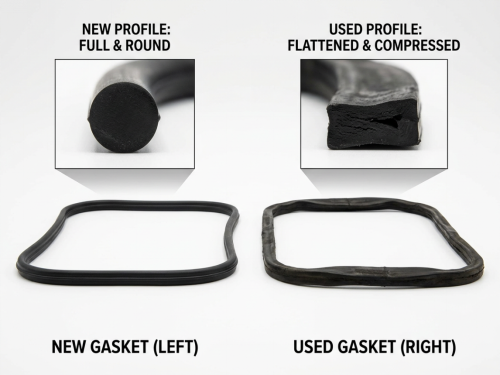
Valve cover gasket over-torque damage occurs when bolt tension exceeds the gasket's compression limit, causing permanent deformation, cracking of the cover boss, or uneven sealing across the flange. Most modern valve cover bolts require only 7–12 Nm — a range that surprises technicians used to head-bolt or main-bearing figures. The problem is that this range feels "too loose" by hand, so a lot of leaks are actually created during installation, not by wear.
The failure modes break down by material. Rubber and silicone gaskets suffer compression set — they lose 20–40% of their original thickness and never spring back, leading to oil leaks at the next thermal cycle. Composite covers crack at the bolt bosses, typically radiating outward from the boss to the flange, and replacement is the only fix. Aluminum covers get stripped threads at the boss (usually M6x1.0), needing a HeliCoil or thread insert to save the part. Grommets crush to a permanent flat and then allow the bolt to loosen as the plastic relaxes over the next 500–1,000 km of driving — which is often when the customer comes back complaining of a fresh leak.
Prevention starts with tools and discipline: always use a calibrated click-type or digital torque wrench (not a beam type for values under 15 Nm — accuracy suffers at the low end); always follow the OEM-specified value and, more importantly, the OEM tightening sequence, which is nearly always center-out in a spiral or cross pattern; replace rubber grommets and the perimeter gasket whenever the cover is reused; and never — under any circumstances — use an impact driver or air ratchet on valve cover bolts. The rotational shock alone can crack a composite boss even when the average torque reads correct.
A workshop scenario we hear repeatedly: a technician replaces a valve cover gasket on a 2.4L Nissan or Toyota, does not torque to spec but instead "goes by feel," and returns the car with a dry engine. Two weeks later the owner reports a fresh leak. The bolts, when checked, are at 18–22 Nm — nearly twice the 10 Nm spec. Two of the bosses have hairline cracks. The gasket is squeezed to less than half its free-state thickness in some spots and barely compressed in others. That is textbook over-torque damage, and it is entirely preventable with a $60 torque wrench.
Comparison in prose: a properly torqued gasket compresses to roughly 60–75% of its original thickness and holds sealing pressure across a temperature range of −30°C to 130°C for 8–10 years. An under-torqued gasket compresses only 30–40% and leaks under thermal cycling within months. An over-torqued gasket may seal briefly, but the plastic creep of the gasket material combined with the flexure of the cover boss almost always produces a leak within one to two years — and often takes the cover with it.
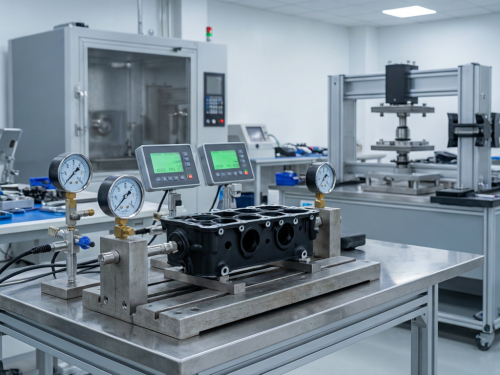
Nansen Auto engineers each of our 150+ valve cover models with bolt boss geometries tested through finite element analysis and physical vibration protocols. Boss wall thickness, boss height, and reinforcement ribs are dimensioned specifically so that the specified torque produces uniform clamp load across all fasteners without exceeding the boss yield stress. This is not something a generic mold can deliver — it comes out of the same design discipline that produced our valve cover invention patent, and it's why our failure-return rate on properly-torqued installations sits below 0.3%.
Common pitfalls and misconceptions: believing that "tighter is safer" for oil-sealing joints — it isn't; that a torque wrench doesn't matter for small bolts — the smaller the bolt, the more critical the torque accuracy; and that a locking compound compensates for correct torque — it doesn't, and thread locker on valve cover bolts often causes more problems than it solves.
FAQ:
FAQ: Q: Can an over-torqued gasket be reused? A: No. Permanently compressed gaskets lose the elasticity needed to accommodate thermal cycling and will leak on the first heat cycle. Replace any gasket that has been over-torqued, even if it looks intact.
FAQ: Q: What's the most common sign of over-torque? A: Oil weeping around one or two bolts while others remain dry indicates uneven or excessive clamping. A visible dimple or depression in the cover around a bolt head is a stronger signal — that boss is likely already cracked underneath.
FAQ: Q: Is there a torque spec I can use as a rule of thumb if I lost the manual? A: 8 Nm is a safe starting point for most composite covers, 10 Nm for aluminum, but always verify against the OEM figure — Honda, Toyota, VW/Audi, and Ford all publish specific values that vary by engine family, and Nansen Auto ships torque data on request for every OE-equivalent part.
FAQ: Q: How does Nansen Auto validate its bolt boss design? A: Each new tooling release goes through a torque-to-failure test where bolts are progressively tightened until the boss cracks. The specified service torque must sit at less than 50% of the failure value. This safety factor is documented in our IATF 16949 design records and re-verified through vibration testing before serial production begins.