 EN
EN

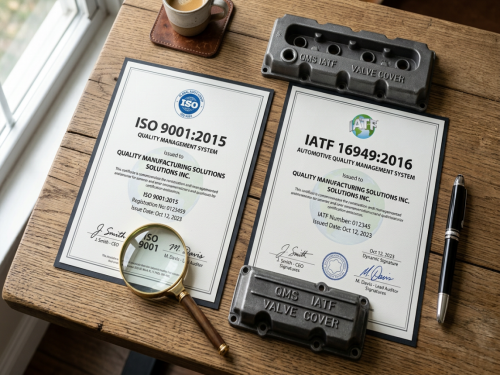
Automotive parts certification validates a manufacturer's quality management system against industry standards, providing buyers with objective evidence that production processes meet defined requirements. IATF 16949 is the highest automotive-specific standard - it replaced ISO/TS 16949 in 2016 and consolidates decades of OEM requirements from Ford, GM, VW, and other founding members. ISO 9001 covers general quality management applicable to any industry, while regional standards like TS extend the framework with sector-specific expectations. Understanding these tiers helps buyers separate marketing claims from validated capability.
ISO 9001 provides a baseline quality management framework: documented processes, corrective action systems, management review, and internal audits on a 3-year certification cycle with annual surveillance. It confirms that a manufacturer has a functional quality system but does not require automotive-specific tools like statistical process control on critical dimensions, comprehensive traceability, or advanced product quality planning. ISO 9001 is appropriate for general industrial parts, decorative accessories, and non-safety-critical components. For engine and drivetrain parts, it is a floor, not a ceiling.
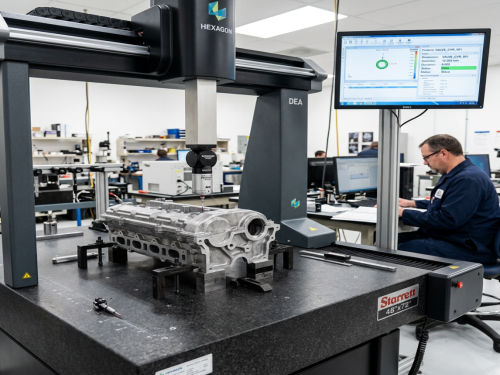
IATF 16949 is automotive-specific and considerably more demanding. Certification requires annual surveillance audits (versus 3-year for ISO 9001), zero major nonconformances at recertification, and evidence of specific automotive tools: Advanced Product Quality Planning (APQP) for every new part launch, Production Part Approval Process (PPAP) documentation submitted to customers before mass production, Process Failure Mode and Effects Analysis (PFMEA) linked to control plans, Statistical Process Control (SPC) on critical characteristics with Cpk targets typically at 1.33 or higher, Measurement System Analysis (MSA) with Gauge R&R under 30%, and full traceability from raw material lot through finished product serial number. The certification also enforces layered process audits, customer-specific requirements from each OEM served, and warranty and field failure analysis loops that feed back into design and process controls.
Comparing the two standards in practical prose form: an ISO 9001 supplier can pass audit with documented procedures and a corrective action log, but may have no statistical evidence that their process actually stays in control between audits. An IATF 16949 supplier must demonstrate ongoing statistical stability on every critical dimension - if a bolt hole location drifts more than 6 sigma outside center, the process must be stopped, root-caused, and reverified before production continues. In the valve cover industry specifically, this translates to verified flange flatness across every shift, PCV port position controlled to +/-0.15mm, and material lot traceability that can identify which resin batch was used on any part shipped in the last 15 years.
Anhui Runming Auto Parts (Nansen Auto) has operated under IATF 16949 certification since our founding in 2017, integrating these protocols from day one rather than retrofitting them onto an existing operation. Across our 10+ injection molding machines ranging from 130T to 650T, we run centralized material feeding with lot control, moisture verification on every PA66-GF resin batch (target under 0.15% before molding), and SPC monitoring on flange dimensions, bolt boss location, and weight - three parameters that predict field failure risk. Our test lab supports the certification with air tightness pressure-decay verification, salt spray per ASTM B117, high-temperature aging at 150C for 500-1000 hours, vibration testing to OEM profiles, and image-based dimensional inspection. Our 26,666 square meter facility supports 1M+ unit annual capacity with 80+ trained employees operating under standardized work instructions traceable to APQP outputs. We also hold a valve cover invention patent that documents specific design innovations for sealing performance and clamp load distribution.
A real-world scenario illustrating the certification gap: an OEM Tier 2 buyer sourced valve covers from an ISO 9001-only supplier at 15% lower cost than the incumbent IATF 16949 supplier. Within 8 months, warranty returns tripled due to intermittent flange warp - the ISO 9001 supplier had no SPC data to identify which lots were affected, forcing a full recall of 6 months of production. The total cost including recall logistics, replacement parts, and lost OEM confidence exceeded three years of the initial cost savings. IATF 16949 traceability would have limited the recall to affected lots, typically 5-10% of the population.
Common industry pitfalls: (1) Accepting certification claims without verifying the certificate number and scope - not all IATF 16949 certificates cover valve covers specifically; scope must match the product. (2) Ignoring the certification body - only IATF-recognized certification bodies (listed on iatfglobaloversight.org) issue valid IATF 16949 certificates. (3) Confusing ISO/TS 16949 with IATF 16949 - the older TS standard expired in September 2018 and is no longer valid. (4) Assuming certification alone guarantees quality - certification means the system exists; execution still varies and should be verified through PPAP samples and site audits.
FAQ:
FAQ: Q: Is ISO 9001 sufficient for automotive parts? A: For non-critical accessories like trim clips or decorative covers, possibly. For engine components including valve covers, oil pans, and intake manifolds, buyers should require IATF 16949 to ensure statistical process control, PPAP documentation, and traceability. Insurers and OEM aftermarket programs increasingly mandate IATF 16949 for engine bay parts.
FAQ: Q: How can I verify a certification? A: Request the full certificate showing certificate number, issue date, expiration date, certification body name, and scope statement. Verify authenticity through iatfglobaloversight.org for IATF 16949, and check the certification body against the IAF (International Accreditation Forum) member list.
FAQ: Q: What is PPAP and why does it matter? A: Production Part Approval Process is a documented submission proving the manufacturer can produce parts to specification at production rate. A full PPAP includes 18 elements: design records, DFMEA, PFMEA, control plan, MSA, initial process studies, dimensional layouts, material certifications, sample parts, and more. For aftermarket buyers, requesting a PPAP Level 3 submission is the strongest evidence of capability.
FAQ: Q: How long does IATF 16949 certification take to obtain? A: Typically 12-18 months for a mature ISO 9001 supplier, longer for greenfield operations. This is why certification age is a useful signal - a supplier certified for 5+ years has demonstrated sustained capability across multiple audit cycles.
FAQ: Q: Does IATF 16949 certification transfer between facilities? A: No. Each production site must be individually certified. Verify that the certificate scope covers the specific facility producing your parts, not just the corporate headquarters.