EN
EN

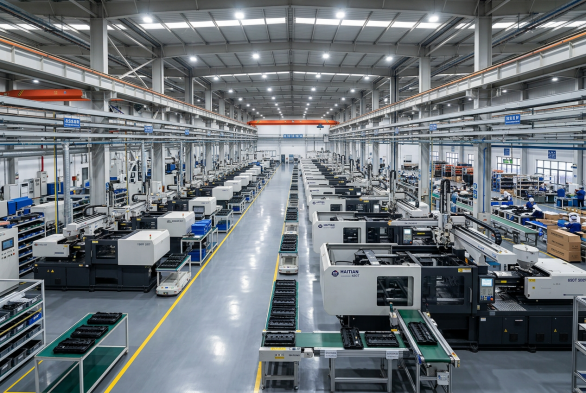
Quick Answer: A centralized material supply system uses a single drying tower and vacuum conveying network to feed multiple injection molding machines simultaneously, replacing the older method of feeding each machine independently. The benefits are: (1) consistent moisture control across all machines, (2) elimination of cross-contamination between materials, (3) reduced labor (one operator vs many), and (4) automatic inventory tracking. Ranmi's facility in Anhui uses such a system for all 10+ injection machines.
How It Works
A centralized system has four functional zones:
Zone 1 — Bulk Storage Raw material silos hold 5–50 tonnes of glass-filled nylon, typically supplied in 1-tonne FIBC (super sacks) or 25 kg bags. Material is identified by lot number for full traceability.
Zone 2 — Drying Tower Compressed air or desiccant drying reduces moisture content from typical 0.5–1.0% (as received) to 0.05–0.10% (process-ready). Insufficient drying is the single largest cause of weld-line failure in glass-filled nylon valve covers.
Zone 3 — Vacuum Conveyance A network of stainless-steel pipes routes dried pellets to each injection machine's hopper using vacuum receivers. Cycle time: 30–60 seconds per pull.
Zone 4 — Hopper Loaders Each injection machine has a small (5–25 kg) buffer hopper that triggers automatic refills via vacuum suction.
Why It Matters for Quality
|
Risk Without Central System |
Risk With Central System |
|
Each machine has its own dryer (variable performance) |
Single drying tower, calibrated and audited |
|
Material handled manually multiple times |
Sealed conveyance from silo to machine |
|
Cross-contamination between materials |
Cleaning loops between material changeovers |
|
Inconsistent moisture from machine to machine |
Uniform moisture across all machines |
|
Manual lot tracking errors |
Automated SCADA logging of lot at each machine |
For IATF 16949 compliance, traceability of raw material from delivery to finished part is mandatory. A centralized system makes this simple; per-machine drying makes it nearly impossible.
Cost Justification
A centralized system for 10 injection machines requires capital investment of approximately USD 150,000–300,000. Operational savings:
- Energy reduction: 30–40% lower drying energy vs ten individual dryers
- Material waste reduction: 1–2% (material left in individual hoppers between runs)
- Labor reduction: 1 system operator vs 4–6 machine attendants for material handling
- Downtime reduction: automatic refill eliminates idle time waiting for material
Break-even point for a 10-machine facility: 18–30 months.
Material Changeover Procedures
Switching from one material grade to another (e.g., PA6-GF30 to PA66-GF30) requires:
- Empty the drying tower to a recovery container
- Run cleaning purge material through the conveyance lines
- Load new material into the silo
- Restart drying for new material's parameters
- Verify first-shot parts before mass production
Total changeover time: 2–4 hours. Without a central system, each machine would require individual changeover (multiplying the time and waste).
FAQ
Q1: What happens if the central system fails? Each machine has a buffer hopper sufficient for 30–60 minutes of production. Backup procedures include manual material refill via small drying hoppers. Critical machines may have redundant feed lines.
Q2: Can different colors run simultaneously? Yes — modern systems use parallel conveyance lines with material-specific routing. Color masterbatch is typically dosed at the machine, not centrally.
Q3: Is this required for IATF 16949 certification? Not explicitly required, but auditors strongly favor centralized systems because they enable reliable traceability and consistency, both of which are IATF 16949 mandatory.