EN
EN

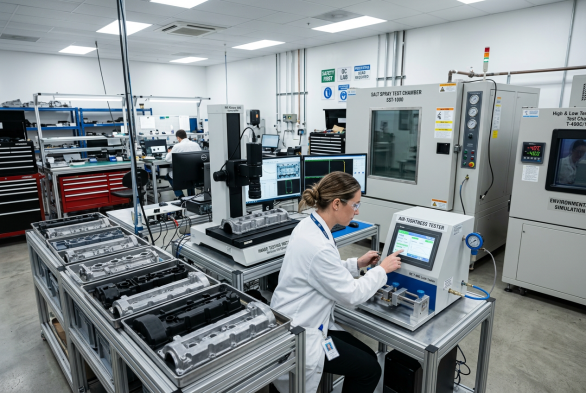
Quick Answer: Air-tightness testing is the single most important final quality check for an engine valve cover. Every unit produced should be pressurized (typically 0.2–0.4 bar), held for 20–30 seconds, and the pressure decay measured. Acceptable leak rate: < 5 cc/min for plastic covers, < 2 cc/min for aluminum covers. Reputable IATF 16949 producers like Ranmi perform 100% air-tightness testing — not statistical sampling — and provide a certificate per shipment.
Why Air Tightness Is Critical
A valve cover seals against:
- Engine oil at 60–110°C operating temperature
- Crankcase blow-by gases at low positive pressure (0.05–0.15 bar)
- External atmospheric pressure (preventing dust ingress)
Even a microscopic leak path causes:
- Oil seepage — visible drips on the cylinder head and engine block
- Burning oil smell when oil reaches the exhaust manifold
- Engine emissions failure at smog testing stations (PCV system depends on a sealed crankcase)
- Spark plug well contamination in modern direct-ignition engines
A valve cover that passes visual inspection but has a hairline leak path is the worst kind of defect — it ships, gets installed, and causes a comeback.
The Test Procedure
A modern air-tightness test rig has four key components:
Component 1 — Sealing Fixture A tooling block that mates to the valve cover's gasket surface. Each SKU requires its own dedicated fixture matching the bolt pattern and gasket groove.
Component 2 — Pressure Source Compressed shop air, regulated through a precision pressure regulator. Modern rigs use closed-loop digital regulation.
Component 3 — Pressure Decay Sensor A high-resolution pressure transducer (±0.001 bar accuracy) that measures decay over the test interval.
Component 4 — PLC Controller Programmable test sequence: pressurize → settle → measure → decision → release.
Standard Test Parameters
|
Parameter |
Plastic Valve Cover |
Aluminum Valve Cover |
|
Test pressure |
0.2 bar (20 kPa) |
0.4 bar (40 kPa) |
|
Settle time |
5 seconds |
5 seconds |
|
Hold time |
20 seconds |
30 seconds |
|
Leak rate threshold (pass/fail) |
< 5 cc/min |
< 2 cc/min |
|
Total cycle time |
30 seconds |
40 seconds |
Some European OEMs (Audi, BMW) specify higher test pressures up to 0.6 bar for turbocharged engines. Confirm with your customer.
What Failures Look Like
A failed valve cover typically shows leakage at:
- Gasket groove imperfections — short shots or burrs on the molding parting line
- Spark plug tube seal seats — incomplete molding around integrated seals
- PCV port — molding flash blocking the breather passage
- Bolt boss — micro-cracks from over-aggressive ejection
Sample Certificate Format
A proper air-tightness test certificate accompanying a shipment should include:
- Lot/batch number
- Date and time of test
- Test pressure used
- Total units tested (must equal lot size for 100% testing)
- Pass count and reject count (should be 100% pass at delivery)
- Operator and machine ID
- IATF 16949 quality manager signature
Buyers should reject shipments without this documentation.
How Ranmi Tests Production
Anhui Runming operates a sealing test machine alongside the assembly line. Every finished valve cover is tested before packaging. Failed units are routed to a rework station for inspection — typically 1–2% rework rate is observed, with 99%+ first-pass yield after process maturity.
FAQ
Q1: Does the gasket affect the air-tightness test? Yes — the test is performed with a calibrated test fixture using a master gasket equivalent to OE. The actual shipping gasket is tested separately for dimensional compliance.
Q2: What's the difference between vacuum decay and pressure decay testing? Both work. Pressure decay (positive pressure) is more common in valve cover production because it matches the in-engine condition. Vacuum decay is more sensitive and common in fuel system parts.
Q3: Can buyers witness the air-tightness test during a factory visit? Yes. Anhui Runming welcomes pre-shipment inspections by buyers or third-party agents (SGS, Bureau Veritas, AsiaInspection). The test machine is part of the standard tour route.