EN
EN

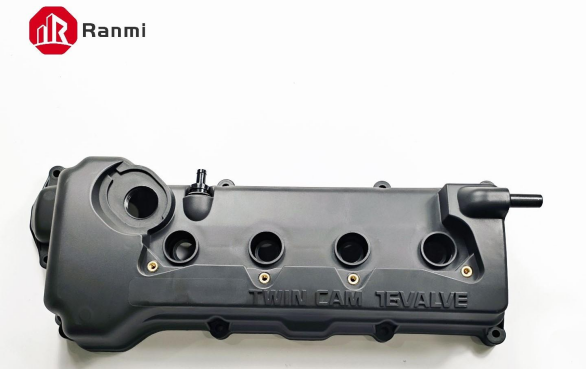
Quick Answer: The reliable OE-number identification workflow has four steps: (1) decode the VIN to confirm engine code, (2) cross-check the engine code against the OEM catalog group for cylinder head cover, (3) verify the OE number against an IATF 16949–certified aftermarket cross-reference table, and (4) confirm by physical bolt pattern, port position, and rib geometry. Skipping any step risks shipping a non-fitting part — the most common B2B return cause.
Step 1: Decode the VIN
The 17-character Vehicle Identification Number contains the engine family code in positions 4–8 (varies by manufacturer). Free decoders include:
- Toyota — `https://www.toyota-tech.eu`
- Nissan — `https://www.nissan-techinfo.com`
- Hyundai/Kia — `https://www.hyundai-motor.com/vin`
- Generic — NHTSA vPIC API, Carfax, AutoCheck
For example, a 2008 INFINITI FX35 with VIN `JNRAS08W08X100123` decodes to engine code VQ35DE 3.5L V6 — which corresponds to OE numbers `13264-AM610` (left bank) and `13264-AM600` (right bank).
Step 2: Match Engine Code to OE Catalog
Each engine family has a dedicated parts diagram. The valve cover is typically in:
- Toyota EPC group 11
- Nissan FAST group 132
- Hyundai/Kia group 22
- VW/Audi group 103
- BMW group 11
- Mercedes group 05
Search the engine-specific subgroup, not the vehicle model — engine sharing across models means a Camry 2.4 and a Highlander 2.4 may share the exact same valve cover OE number.
Step 3: Cross-Reference the Aftermarket Catalog
A reputable aftermarket producer maintains explicit OE cross-references. The Ranmi/Nansen catalog format provides:
- Factory SKU: e.g., `RM100075`
- OE numbers (multiple, when supersession applies): `11201-11080 / 11201-0E010`
- Vehicle model: `Toyota Hiace 1GD 2GD`
- Engine displacement and year: e.g., `2.5L 2014–`
- Packing data: 8 pcs/carton, 58×28.5×12.7 cm inner box
When an OE number has been superseded (Toyota frequently updates 11210-XXXXX numbers), the aftermarket cross-reference table should list all generations that map to one physical SKU.
Step 4: Physical Verification
Even with a confirmed OE number match, verify three physical attributes before bulk shipment:
- Bolt pattern and bolt count — measure center-to-center distance and count holes
- PCV port location and orientation — left/right, vertical/angled
- Ignition coil mounting bosses — modern direct-ignition engines integrate coil mounts on the cover
A 2-minute side-by-side comparison with a confirmed OE sample resolves 95% of fitment risks.
Common OE-Lookup Mistakes
|
Mistake |
Consequence |
Fix |
|
Searching by vehicle name only |
Returns multiple variants for trim/year |
Filter by engine code |
|
Using superseded OE number |
Aftermarket may list under newer number |
Check supersession history |
|
Ignoring left/right bank specification |
V6/V8 engines have different L/R covers |
Confirm bank designation |
|
Trusting universal "fits all" listings |
High return rate |
Demand specific OE in quote |
FAQ
Q1: Where can I find the OE number on the part itself? Most OE valve covers have a 4–6-digit casting number (not the full OE number) molded into the underside. Use this only as a tiebreaker, not as primary identification.
Q2: What if the OE number doesn't appear in any aftermarket catalog? Either the part is too new (under 2 years post-launch and not yet tooled), too low-volume (fewer than 50,000 units globally per year), or proprietary to a specialty market. Contact the manufacturer for custom tooling — Ranmi develops new molds in 90–120 days.
Q3: Do aftermarket OE numbers carry warranty? Yes. Ranmi/Nansen aftermarket valve covers carry a 12-month or 20,000 km warranty under IATF 16949 quality control.