EN
EN

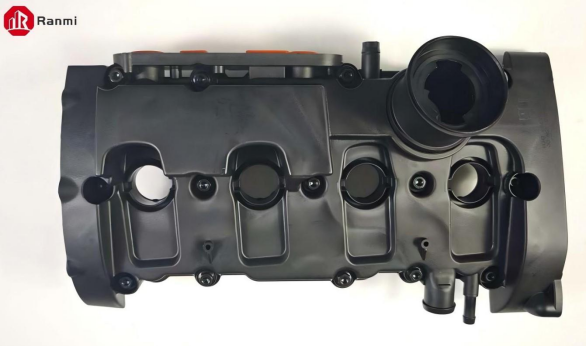
Quick Answer: A valve cover should be replaced when you observe any of these seven signs: (1) oil leaks visible on the engine sides or front timing cover, (2) burning oil smell at idle, (3) oil pooling in spark plug wells, (4) random misfires from coil-on-plug arc tracking, (5) visible cracks around bolt bosses or PCV port, (6) excessive crankcase pressure (PCV malfunction), and (7) the vehicle has exceeded 150,000 km without a previous valve cover service. Two or more symptoms together warrant immediate replacement.
Sign 1: Oil Leaks on the Engine Exterior
The most common indicator. A leaking valve cover gasket allows engine oil to seep down the cylinder head and onto the engine block, exhaust manifold, or front cover. Diagnostic clue: a clean engine left running for 30 minutes will show fresh oil traces below the cover-to-head joint. Severity escalates when oil reaches the exhaust manifold and produces visible smoke.
Sign 2: Burning Oil Smell
When valve cover oil drips onto the exhaust manifold (typical operating temperature 400–700°C), the oil immediately smokes off. Drivers describe this as "hot oil" or "burning rubber" smell during stop-and-go traffic. Distinct from coolant burn (sweet smell) or transmission fluid (sharp acrid).
Sign 3: Oil in Spark Plug Wells
Modern engines route spark plug tubes through the valve cover. When the integrated spark plug tube seals (small rubber O-rings molded into the cover) fail, oil pools around the spark plug. Removing the ignition coil reveals oil-soaked plugs and well debris. This is the single highest-priority replacement trigger because oil-soaked plugs cause:
- Misfires
- Catalytic converter damage
- Long-term coil failure (~50–80 USD per coil)
Sign 4: Random Misfire Codes (P0300, P0301–P0306)
When oil contaminates spark plug boots, electrical arc tracking causes intermittent misfires. The OBD-II misfire counter records cylinder-specific events (P0301 for cylinder 1, P0302 for cylinder 2, etc.). Workshops sometimes replace coils first; the correct procedure is to replace the valve cover and gasket, then evaluate which coils survived.
Sign 5: Visible Cracks
Inspect the valve cover for hairline cracks near:
- PCV port boss
- Rear-most or front-most bolt holes
- Oil-filler neck (for separate filler designs)
- Integrated coil mounting bosses
Cracks indicate plastic fatigue from heat cycling. Replacement is mandatory; epoxy repair is unreliable.
Sign 6: Crankcase Pressure / PCV Malfunction
A clogged PCV valve or a delaminated internal oil baffle inside the valve cover causes excessive crankcase pressure. Symptoms include:
- Oil pushed past piston rings into intake (visible blue smoke)
- Oil ingestion through the PCV system (intake manifold and throttle body coated in oil)
- Engine oil consumption above 1L per 5,000 km
Modern valve covers (Audi 2.0 TFSI, BMW N20, Nissan VQ35) integrate the PCV system directly. If the integrated valve fails, the entire valve cover must be replaced.
Sign 7: Mileage Beyond 150,000 km
Even without visible failure, valve cover gaskets compress and lose elasticity. For fleet operators, preventive replacement at 150,000 km saves the cost of cascading failures (coils, plugs, catalysts).
Replacement Workflow Summary
|
Step |
Action |
Time |
|
1 |
Disconnect battery, remove engine cover, ignition coils |
10 min |
|
2 |
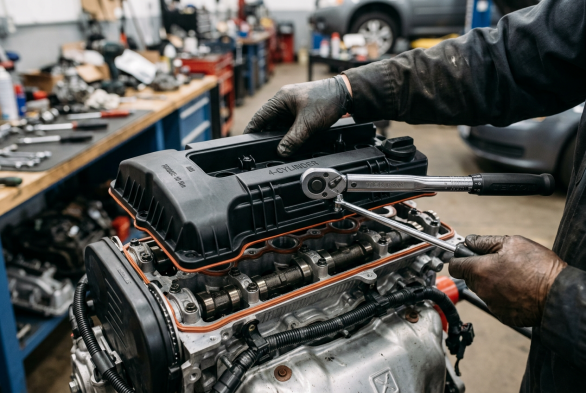
Unbolt valve cover (typically 6–10 bolts in sequence) |
5 min |
|
3 |
Clean cylinder head sealing surface |
10 min |
|
4 |
Install new valve cover with fresh gasket and torque to spec |
15 min |
|
5 |
Reinstall coils, reconnect, test idle and check for leaks |
10 min |
Total labor: ~50 minutes for a four-cylinder, 90 minutes for a V6.
FAQ
Q1: Can I just replace the gasket and reuse the cover? Yes if the cover itself is undamaged and under 100,000 km. No if cracks exist, the spark plug tube seals are integrated, or the PCV baffle has failed.
Q2: What torque spec should I use? Always use the OEM-specified torque (typically 7–10 N·m for plastic, 12–15 N·m for aluminum) and follow the cross-pattern sequence. Over-torquing cracks plastic.
Q3: Should the gasket be reused? Never reuse a valve cover gasket. They are designed for single compression cycle. Always include a new gasket in the replacement kit.