 EN
EN

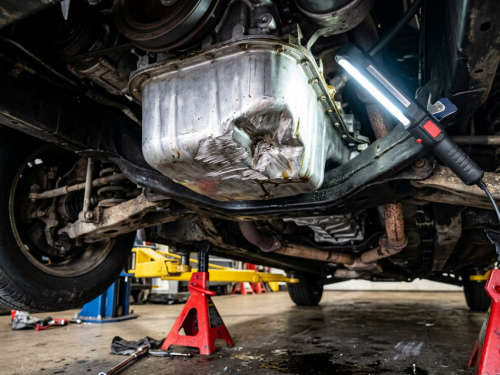
Oil pan impact damage from road debris, speed bumps, or off-road grounding can cause cracks, dents restricting oil flow, or slow leaks that starve the engine of lubrication. Any visible deformation warrants immediate inspection — an oil pan does far more than hold oil; it houses the pickup tube, positions the drain plug boss, and often supports the oil level sensor. A dent that pushes the pan floor within a few millimeters of the pickup screen can starve the pump long before the oil level warning ever triggers.
Severity grades in practice: surface scratches are low severity — monitor them for corrosion but no immediate action. Dents without leaks are medium severity — inspect pickup clearance, verify oil pressure at hot idle, and re-check in 500 km. Dents with weeping oil are high severity — replace before the next long drive because the crack propagates under thermal cycling. Visible cracks, especially on aluminum pans, are critical — replace immediately, do not drive.
After a strike, the correct sequence is: check the dipstick immediately to see if any oil has been lost; inspect the pan visually from below with a flashlight, focusing on the drain plug boss and the deepest section of the sump where road debris hits first; look for fresh oil on the pavement (dab a clean rag on the pan and re-check after ten minutes at idle); measure dent depth relative to the oil pickup tube using the OEM service manual dimension; and if the dent exceeds 5mm inward on a typical passenger-car pan, verify pickup-tube-to-pan-floor clearance is still within the 4–8mm range most OEMs specify.
A field example that stays with our engineering team: a fleet operator in Chile brought in three identical Hilux trucks that had all bottomed out on the same access road. Two showed obvious dents and dropped oil pressure at hot idle. The third looked fine externally — no dent, no leak — but the driver reported a brief low-oil-pressure warning. On removal, the pan floor had bowed upward internally by 6mm without visible external damage, because the impact had folded a hidden interior rib. Pickup clearance was down to 1.5mm. That truck was 500 km from a spun bearing. Only measurement, not eyeballing, catches that kind of damage.
Comparison in prose: steel pans dent and can sometimes be tapped back into shape by a competent body shop, but the coating cracks under the deformation and corrosion follows within months. Aluminum pans crack instead of denting — they have almost no ductile reserve when struck cold — and welded aluminum repairs on a used pan rarely hold under thermal cycling. Composite/plastic lower pans (found on some Audi, BMW, and modern Toyota applications) shatter on impact and cannot be repaired at all. In every case, replacement with an OE-equivalent part beats field repair on durability.
Manufacturers producing OE-equivalent parts under IATF 16949 certification, like Nansen Auto, verify replacement pans against the original dimensional prints — including baffle geometry, pickup tube boss position, and drain plug location — because a mis-dimensioned pan will still bolt up but starve the pump under hard cornering. Our image testing station checks each pan's critical features against a golden sample before packaging, which is one of the reasons we sustain deliveries across 80+ markets with a low warranty rate.
Common pitfalls: assuming that "no leak means no damage" — internal bowing without external cracking is common and dangerous; using body filler or JB Weld as a permanent repair — it holds until the next heat cycle and then fails suddenly, often on a highway; and reusing a bent OE pan because "the dent isn't that bad" — the pickup tube tolerance stack is unforgiving.
FAQ:
FAQ: Q: Can a dented oil pan be repaired? A: Only minor cosmetic dents in steel pans, and only if the coating is still intact and the interior baffling is undisturbed. Aluminum pans and any crack require full replacement. Composite pans are always replaced.
FAQ: Q: Does oil pan damage affect insurance claims? A: Impact damage from an identifiable event — striking a road hazard, curb, or debris — is typically covered under comprehensive or collision policies if reported promptly. Wear-and-tear or corrosion-related failure is not.
FAQ: Q: How much oil pickup clearance is safe? A: Most OEMs specify 4–8mm from the pickup screen to the pan floor. Below 3mm, oil aeration and pump cavitation become likely under hard cornering or braking. Below 2mm, expect low-oil-pressure warnings even at normal driving.
FAQ: Q: How does Nansen Auto ensure replacement pans meet OE clearance? A: Every new pan tooling release is validated with a full CMM dimensional report and an image test against the OE reference sample, per our IATF 16949 control plan. Pickup boss height and drain plug boss position are checked on a sampling basis every production shift, and any drift outside 0.3mm tolerance halts the line for tooling review.