 EN
EN

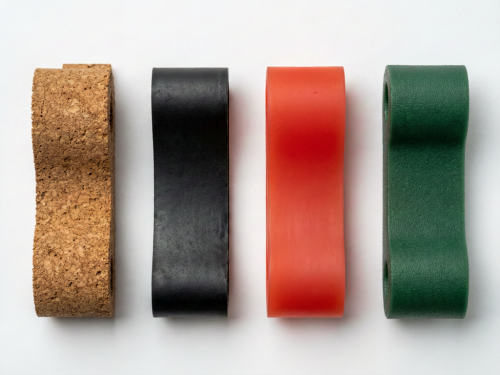
Valve cover gasket material determines seal longevity, temperature resistance, chemical compatibility with engine oil, and resistance to compression set — the tendency of a compressed elastomer to permanently deform and lose sealing force over time. Molded rubber and silicone profiles dominate modern engines, while traditional cork is largely obsolete except on classic and heritage applications.
Each material family has distinct performance characteristics. Cork gaskets handle a working range of -30°C to +120°C with a typical 2-4 year service life. They rely on physical compression to seal but exhibit poor compression set resistance — meaning that after being torqued down and heat-cycled, cork permanently loses thickness (compression set values of 40-60% are typical) and stops sealing. Nitrile rubber (NBR) operates from -40°C to +130°C and lasts 5-7 years in typical service. It has good resistance to engine oil but degrades on prolonged exposure to modern low-viscosity synthetics with ester chemistry — an underappreciated failure mode on engines running long drain intervals.
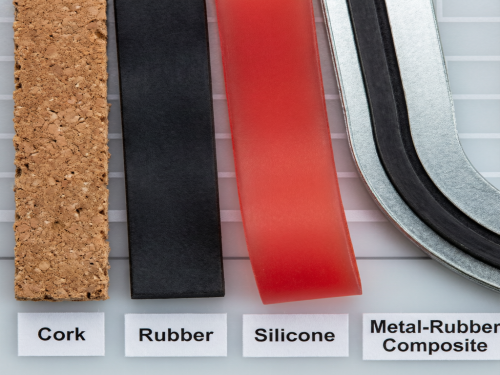
Silicone (VMQ) is the current workhorse across most Japanese and Korean applications, operating from -60°C to +200°C with a 7-10 year service life and excellent compression set resistance (typically under 20% after 1000 hours at 150°C in our aging tests). Molded FKM (Viton) handles -20°C to +230°C for 10+ years with the best compression set numbers we measure — often under 12% — but at 3-5x the material cost of standard silicone. FKM is specified on high-thermal-load applications: Ford EcoBoost, some VW/Audi TSI covers, and diesel applications where oil temperatures routinely exceed 130°C.
In prose comparison: cork is cheap, forgiving of imperfect flatness (it fills gaps up to about 0.3 mm), and completely obsolete for modern service — its lifecycle is simply too short. NBR is the value choice for older naturally-aspirated engines and general-purpose applications. Silicone is the modern default: excellent thermal range, long life, good chemical compatibility, and moderate cost. FKM is the premium choice for high-temperature and diesel applications where operating conditions justify the added expense.
A workshop misconception worth addressing: many technicians reach for a bead of silicone RTV as a "backup seal" alongside a molded gasket. In our factory testing, this often makes the seal worse. RTV cures at a different rate than the compressed gasket relaxes, and it can prevent the molded profile from seating evenly. The correct approach is a clean, dry mating surface and the correct molded gasket alone — with RTV reserved only for specific OEM-designated corners (typically the four corners of certain V-engine covers where the head-to-block junction creates a step).
A case from a Honda K20 rebuild we consulted on: the technician had used a generic "universal" NBR gasket with a bead of RTV "just to be safe." The cover leaked from three corners within 2,000 km. Swapping to the correct molded silicone profile (part of a genuine or IATF 16949-certified aftermarket kit) with no additional sealer resolved it permanently.
Nansen Auto produces valve covers with integrated molded gasket profiles across 150+ models using IATF 16949-certified processes. Our high-temperature aging tests run at 150°C for 1000 hours (equivalent to roughly 10 years of typical service based on Arrhenius aging models), with compression set measured before and after and required to remain under 25%. Air tightness verification runs at 30 kPa differential across a fixture that reproduces the actual cylinder head sealing surface — not a flat test plate — which is how we catch geometry issues that would show up on a real engine.
A specific compatibility note that trips up rebuilders: some aftermarket "performance" oils and fuel-treatment additives contain zinc dialkyldithiophosphate (ZDDP) at levels above what OEM silicone formulations were validated for. On engines running these fluids continuously, we've seen silicone gasket life reduced from 8+ years to 4-5 years. If a rebuilder plans to run high-ZDDP oils, FKM is the safer material choice.
We should be honest about what a gasket cannot fix: a warped cover flange, a scored head sealing surface, or a cracked internal baffle. If the gasket has been replaced twice and still leaks, the problem is almost certainly upstream of the gasket itself. A precision straightedge check of both mating surfaces is the diagnostic step most workshops skip.
One final material note: on Nissan VQ-series V6 covers and many similar V-engine designs, the gasket includes multiple integrated grommets around the spark plug tubes. These grommets are usually the same silicone family but face harsher thermal cycling because the plug tubes conduct combustion heat directly. When a valve cover leaks oil into the spark plug wells, the grommets — not the perimeter gasket — are almost always the actual culprit.
FAQ:
FAQ: Q: Why did manufacturers abandon cork gaskets? A: Cork compresses permanently under thermal cycling, losing seal force within 2-3 years, and cannot handle modern operating temperatures above 130°C. Silicone and FKM molded profiles maintain sealing force for 7-10+ years, which matches modern service intervals.
FAQ: Q: Can silicone RTV replace a molded gasket? A: Only as a very short-term emergency repair. Molded profiles provide consistent compression geometry that liquid sealants cannot replicate, and RTV squeezed into a channel often prevents the intended seal from seating. Use RTV only where OEM specifically calls for it (typically corner junctions).
FAQ: Q: How do I know when a valve cover gasket needs replacement? A: Look for oil seepage along the flange edge, oil in the spark plug wells (grommet failure), or a smell of burning oil on the exhaust manifold. On silicone gaskets, replacement is typically at 100,000-150,000 km or whenever the cover is removed for any other service.
FAQ: Q: Should I torque the cover bolts a second time after a heat cycle? A: On some designs yes — Toyota specifies a re-torque after first heat cycle on certain valve covers. Check the OEM procedure. On silicone profiles the initial torque is usually stable, but a light re-check at 500-1000 km can catch installation issues before they become leaks.