 EN
EN

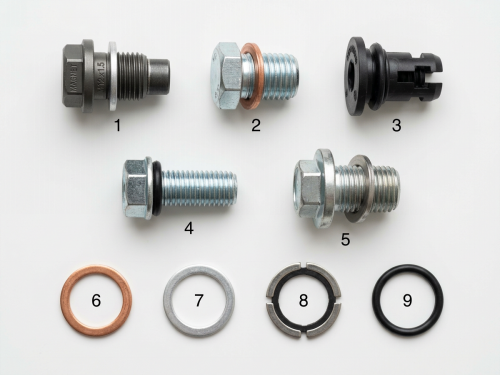
Oil pan drain plug types vary by thread diameter, pitch, sealing method, and head style depending on vehicle manufacturer. Selecting the wrong plug damages threads, causes leaks, and in a worst case may result in catastrophic oil loss on the highway — the kind of failure that turns a $5 drain plug into a $6,000 engine replacement.
Drain plug engineering is more nuanced than it looks. The plug must reliably seal against 3-6 bar of hot oil pressure at operating temperature, resist loosening from vibration across 5,000-10,000 duty cycles, and tolerate the range of over-torque behaviors that real-world quick-lube shops actually apply (which we've measured to range from 15 Nm on the low side to over 80 Nm on the high side — far above any OEM spec).
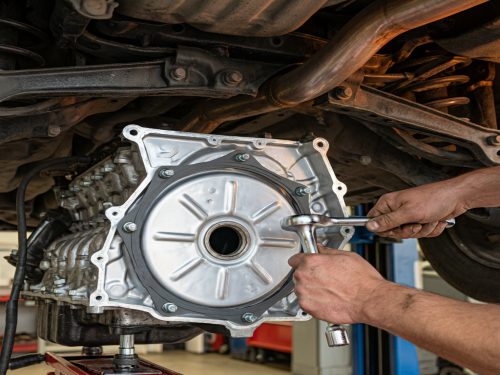
Toyota and Honda commonly specify M14x1.5 with aluminum crush washers and 14mm hex heads at 25-30 Nm. The aluminum washer is single-use for a reason: it plastically deforms during first tightening to fill the microscopic irregularities in the pan boss surface, and cannot restore that seal on reuse. Hyundai and Kia prefer M14x1.5 with copper crush washers and 17mm hex heads at 35-45 Nm — copper is more forgiving than aluminum on reuse but should still be replaced every service for reliable sealing.
VW and Audi use plastic expanding drain plugs on many modern applications (EA888, MQB platform 1.4/1.5 TSI). These are torqued to a much lower 20-25 Nm and use an internal expanding ring rather than a crush washer — they must be replaced every oil change without exception, since the expansion feature is single-use. Ford commonly uses M12x1.75 or M14x1.5 with rubber O-ring seals and 15mm hex heads torqued to 25-35 Nm. The O-ring must be inspected for cuts or flattening; a compressed O-ring loses about 20% of its sealing force per compression cycle. GM and Chrysler applications typically specify M12x1.75 with steel crush washers or gaskets at 25-35 Nm.
Comparing sealing methods in prose: aluminum crush washers are the most forgiving of minor surface irregularities but least forgiving of reuse. Copper washers tolerate 1-2 reuse cycles but leak reliably beyond that. Rubber O-rings offer the widest thermal-cycling tolerance but are vulnerable to cuts from a burr on the pan boss, so many technicians add a light film of clean engine oil to the O-ring during installation. Plastic expanding plugs deliver the most consistent seal — the plastic conforms perfectly on first install — but are absolutely single-use and about 3-5x the unit cost.
A workshop misconception we hear regularly: "if it's not leaking, it's tight enough." In reality, an under-torqued plug can back out slowly from vibration over weeks or months, especially on engines with strong second-order shake (typical of inline-4 designs above 2.2L displacement without balance shafts). A torque wrench in Nm is the right tool here, not a technician's calibrated forearm.
A case a mechanic in our supply network described: a Nissan Altima 2.5L (QR25DE, M12x1.25 plug) came back with a low-oil warning three weeks after service. The plug was still in place but hand-tight — the technician had "snugged" it rather than torqued it, and normal engine vibration had walked it out about a full turn. Fortunately caught before oil starvation caused bearing damage; a proper 25 Nm torque with a fresh crush washer resolved it.
Nansen Auto manufactures drain-compatible oil pan assemblies across all these OEM standards, with pan boss dimensions validated to ±0.05 mm on the sealing face and thread depth held to ±0.2 mm. Each pan design passes air tightness testing at 30 kPa for zero-leak performance at operating pressure, and vibration testing to SAE J1455 to confirm thread durability across at least 15 simulated oil-change cycles. Our IATF 16949 process capability studies show a Cpk above 1.67 on the sealing face flatness and boss position across the 26,666 sqm Si County facility.
We should be honest about aluminum oil pan risk: aluminum drain plug threads strip between 35-45 Nm — well within reach of a technician using a long-handle ratchet without a torque wrench. Most OEMs specify 25-35 Nm precisely because they need headroom against this failure mode. If threads are stripped, options are: a thread insert (Time-Sert or Heli-Coil, typically $50-150 labor), an oversized self-tapping drain plug (a field repair that works but limits future service), or oil pan replacement. Our factory recommendation is prevention: use a torque wrench, replace the washer every time, and never chase a leak by over-torquing.
One final pitfall: cross-threading on installation. Modern aluminum pans are unforgiving of misaligned starts. The plug should thread in fully by hand for at least 3-4 turns before any tool touches it. If it binds early, back it out completely and re-start — never force it.
FAQ:
FAQ: Q: Can a drain plug be over-torqued? A: Yes. Aluminum oil pan threads strip between 35-45 Nm; most OEMs specify 25-35 Nm precisely to leave headroom. Steel pans tolerate more but the crush washer or gasket is usually the weak link above about 50 Nm.
FAQ: Q: How often should crush washers be replaced? A: Every oil change without exception. Aluminum washers plastically deform on first use and cannot restore full seal on reuse. Copper is slightly more forgiving but still best replaced. Rubber O-rings and plastic expanding plugs are strictly single-use.
FAQ: Q: What if I lose my drain plug or bring the wrong one? A: Match thread diameter, pitch, and sealing type exactly. Substituting an M14x1.5 for an M14x1.25 (or vice versa) will start threading and then destroy the pan threads within 3-5 turns. A digital thread gauge and the OEM parts catalog are the safe way to verify.
FAQ: Q: Are magnetic drain plugs worth using? A: On engines with iron cam or bearing wear surfaces, yes — a magnetic plug catches ferrous wear particles between changes and is a useful early-warning of bearing wear if you inspect it each service. Modern all-aluminum engines see less benefit since the wear particles are non-magnetic.+