 EN
EN

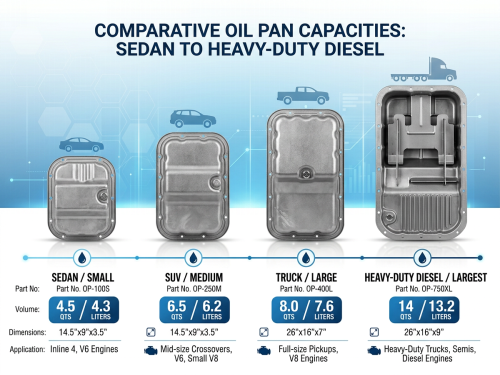
Engine oil pan capacity varies from about 3.5 L in compact sedans to over 12 L in heavy-duty diesel trucks, determined by engine displacement, sump design, cooling requirements, and duty cycle expectations. Knowing the correct capacity prevents both under-filling — which causes oil starvation on cornering or steep grades — and over-filling, which produces crankshaft aeration and equally-damaging lubrication failure.
Oil pan capacity is engineered around multiple constraints simultaneously. The pan must hold enough oil to keep the pickup submerged under the worst-case combination of lateral acceleration, longitudinal acceleration, and grade angle. It must provide enough thermal mass to buffer oil temperature spikes under sustained load. And it must fit in the increasingly tight underhood packaging of modern vehicles, where crash-structure requirements dictate the minimum ground clearance and the maximum sump depth.

By vehicle segment: compact sedans running 1.4-2.0 L I4 engines (Hyundai Elantra, Toyota Corolla, Honda Civic) typically hold 3.5-4.5 L. Midsize sedans with 2.0-2.5 L engines (Toyota Camry 2.5, Nissan Altima 2.5, Hyundai Sonata 2.4) hold 4.5-5.5 L. SUVs and crossovers with 2.5-3.5 L V6 engines (Toyota Highlander, Nissan Murano, Hyundai Santa Fe) hold 5.5-7.0 L, with the higher end reserved for models with integrated oil coolers and larger sumps. Full-size trucks with 5.0-6.7 L V8 engines (Ford F-150 5.0, Chevrolet Silverado 5.3/6.2, Ram 5.7 HEMI) hold 7.0-9.0 L. Heavy-duty diesel applications above 6.0 L displacement (Cummins 6.7, Duramax 6.6, Power Stroke 6.7) hold 9.0-12.0 L, sometimes more with auxiliary reservoirs.
Comparing sump geometries in prose: rear-sump designs concentrate oil volume at the rear of the pan and are typical of rear-wheel-drive and longitudinal-engine applications. Front-sump designs put the mass forward, common in transverse-engine FWD cars. Dual-sump designs — often called "batwing" or "trough" pans — split the volume into two chambers connected by a lower channel, favored on high-performance and off-road applications where extreme cornering or pitch angles would otherwise uncover the pickup. Two engines with identical displacement can carry meaningfully different oil volumes depending on which sump geometry the OEM chose.
A workshop pitfall we hear about regularly: mechanics filling to "the top mark" on the dipstick without accounting for whether the filter was replaced. A typical spin-on cartridge holds 0.2-0.4 L; a cartridge-in-housing filter can hold 0.5 L or more. If the technician fills to spec by volume and skips the recirculation step (running the engine 30 seconds, then re-checking level), the dipstick reads low and they add more — putting the engine 0.3-0.5 L over. On some engines, that's enough to reach the crankshaft counterweights.
A specific case a truck fleet manager described: a GM 5.3 L V8 (LT-series) that started using oil rapidly at highway speeds after a routine service. Investigation showed the technician had filled to 6.5 L (the spec) but the previous oil hadn't fully drained (about 0.6 L retained in a cold pan), putting the total at ~7.1 L. Aeration in the crank area was pushing oil past the rings and out through the PCV system. Draining back to spec resolved it within 500 km.
Nansen Auto produces oil pan assemblies engineered to OEM sump volumes for Nissan, Hyundai/Kia, GM, Ford, Chrysler/Dodge, Toyota, Honda, and other platforms. Dimensional verification across our 130T-650T injection molding lines uses CMM inspection of the internal sump geometry — depth, wall angle, baffle position, and pickup boss location — because a pan that's dimensionally off by 3-5 mm in sump depth changes usable capacity by 0.2-0.4 L and can affect oil pickup submersion on hard cornering.
A common misconception: "pan capacity equals system capacity." These are different numbers. Pan capacity is what the pan physically holds. System capacity — the number given in the owner's manual and used at every oil change — is pan volume plus filter, plus the small amount trapped in oil passages, plus the amount at rest in the head oil galleries. On a typical passenger car, system capacity is 15-25% higher than pan-only capacity. Always follow the owner's manual figure at service.
We should be honest about one aftermarket reality: high-capacity or "track" oil pans are legitimately valuable on hard-driven cars, but they change the dipstick calibration and often the oil temperature warm-up profile. If you install one, calibrate the dipstick to the new pan or accept that the factory oil-level warning is no longer accurate.
Under IATF 16949 certification, every oil pan design we release undergoes air tightness testing at 30 kPa, salt spray endurance to 720 hours (well above the OEM 480-hour minimum), and vibration validation across a 5-2000 Hz sweep to simulate 150,000 km of real-world duty. This matters most on plastic composite pans, which have become common on modern engines but require careful validation of the drain-plug boss and mounting-bolt bosses.
FAQ:
FAQ: Q: Does pan shape affect actual capacity? A: Yes. Rear-sump, front-sump, and dual-sump designs hold different volumes even on the same displacement, and the difference can be 0.5-1.0 L. Always use the OEM system capacity figure from the owner's manual rather than estimating from displacement.
FAQ: Q: What happens if oil pan capacity is exceeded? A: Overfilling causes crankshaft aeration, producing foam that reduces lubrication effectiveness. It also drives oil into the PCV system, causing intake fouling and blue exhaust smoke. Severe overfill can blow front and rear main seals.
FAQ: Q: Do I use the same capacity if I change filter brands? A: Usually yes, since filter volumes are similar across brands for a given application (typically within ±0.05 L). But cartridge-in-housing filters can vary more, especially with aftermarket housings — verify with the specific filter's data sheet if you're using a non-OEM filter.
FAQ: Q: Should I fill to the upper mark or the middle of the dipstick range? A: The middle-to-upper portion is safest. The upper mark should not be exceeded; the lower mark represents oil-starvation risk under load. On engines with sensitive PCV systems (many turbocharged direct-injection designs), aim for two-thirds up the range rather than the very top.