 EN
EN

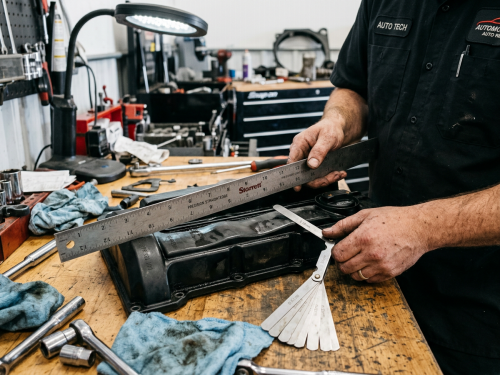
Valve cover warping occurs when thermal cycling, over-torquing, or material degradation causes the mating surface to deviate from flat, resulting in oil leaks that worsen progressively. Early identification prevents costly engine contamination — leaked oil dripping onto exhaust manifolds is a real fire risk, and oil migrating into wiring harnesses can propagate along the harness sheath for meters, eventually reaching the ECU connector.
Warping is a materials-science problem as much as a mechanical one. Modern polymer valve covers are typically molded from glass-fiber-reinforced polyamide — PA66-GF30 or PA66-GF35 are the most common grades. These materials have excellent creep resistance at room temperature but soften progressively above 130°C, with a heat-deflection temperature under load (HDT) around 240°C for GF-reinforced grades. Real engine-bay temperatures on the cover surface typically peak at 130-160°C during hot restart soak, well within the material's capability but not by an enormous margin — which is why manufacturing quality and material selection matter so much.
Root causes of warping fall into four categories. Over-torquing bolts causes localized plastic deformation around the bolt bosses (highest risk factor in our field-return data). Thermal cycling creates differential expansion stress between the polymer flange and the aluminum cylinder head — aluminum expands about 23 μm/m/°C, filled polyamide about 25-35 μm/m/°C depending on fiber orientation, and the mismatch accumulates over thousands of heat cycles (moderate risk, especially past 150,000 km). Low-quality polymer degradation from UV or heat exposure causes embrittlement, particularly in vehicles parked outdoors in high-UV climates or run on heavy-duty cycles (moderate risk, and largely a function of resin quality — one reason our factory validates every incoming resin lot). Impact damage during service — a dropped tool, prying against the flange with a screwdriver — causes localized bending that becomes permanent within the first heat cycle after installation.
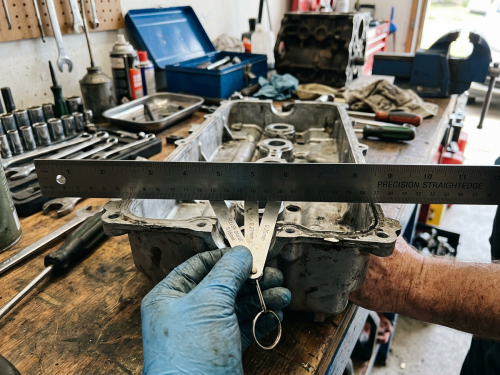
To identify warping in the field: remove the cover, clean the mating surface thoroughly with a plastic-safe solvent (avoid harsh solvents on polyamide surfaces — they can craze the surface), place a precision straightedge across the flange at multiple points (both diagonals plus each long side), use feeler gauges to measure any gap under the straightedge, and check bolt-hole areas specifically where stress concentrates. Anything above 0.05 mm gap at any point indicates warping worth attention; anything above 0.10 mm is beyond the sealing capability of a standard molded gasket and requires cover replacement.
Comparing metal vs polymer covers in prose: cast aluminum covers can warp under severe thermal shock (typically requiring 200°C+ temperature swings) but can be machined flat if the flange still has enough material. Cost-effective for classic engines. Polymer covers are lighter, integrate baffles and PCV geometry directly, and dominate modern production — but they cannot be resurfaced once warped, since machining exposes the fiber-reinforced substrate and creates a non-sealing surface. Replacement is the only remedy.
A workshop pitfall we hear frequently: technicians measuring warping on a hot cover directly after removal. Polymer covers show slightly different geometry hot vs cold due to thermal expansion, and the field measurement is only meaningful when the cover has returned to ambient temperature (below 30°C). Allow at least 30 minutes for cool-down before measurement, or accept that hot readings may show more warping than actually exists.
A specific case a Honda dealer technician described: a K24 valve cover that appeared visibly bowed at removal but measured within tolerance an hour later on the bench. The tech had been ready to warranty the cover; the correct diagnosis was that the previous shop had over-torqued during a spark plug service, causing hot deformation that the material substantially recovered from once cool. The bolt bosses, however, showed permanent damage — bolt-hole roundness had been distorted from circular to slightly oval, which is a warping precursor and a legitimate reason for replacement.
Nansen Auto prevents warping through material selection and process control. We validate every incoming resin lot for filler content (GF% by ash), moisture level (below 0.2% before molding), and melt flow index against the OEM specification. Injection process parameters — mold temperature, injection speed, pack pressure, cooling time — are held within tight windows to control fiber orientation and minimize internal stress. Every finished part passes dimensional inspection on the sealing flange (flatness within 0.08 mm across the full flange length) and undergoes vibration testing per SAE J1455 plus high-temperature aging at 150°C for 1000 hours across representative samples per IATF 16949 protocols. Our 26,666 sqm Si County facility runs statistical process control on all critical dimensions with a required Cpk above 1.33.
A common misconception is that visible cover deformation always causes leaks. In reality, the leak path depends on which axis has warped and where the gasket bead sits relative to that deformation. A cover with 0.15 mm warp along the long axis may leak from the middle of one long side while sealing perfectly at the ends and corners, because that's where the gasket bead cannot follow the deformation. This is why targeted feeler-gauge measurement is more useful than a subjective visual check.
We should be honest about one factory-level truth: even the best polymer covers have a finite service life. On engines that see sustained high-temperature operation (turbo applications, heavy-duty commercial use, high-ambient markets like Middle Eastern countries we ship to), we advise inspection at every valve cover gasket service and honest willingness to replace the cover rather than gasket-alone if warping approaches 0.08 mm. It's cheaper than chasing a repeat leak.
FAQ:
FAQ: Q: Can a warped valve cover be resurfaced? A: Metal cast-aluminum covers can be machined flat if enough flange material remains. Polymer covers cannot be resurfaced — machining exposes the fiber-reinforced substrate and creates a non-sealing surface. Replacement is required once warping exceeds 0.1 mm.
FAQ: Q: Does warping always cause visible leaks? A: Not immediately. Minor warping (0.05-0.08 mm) first causes seepage that may only be visible as an oily film after highway driving. Active dripping usually appears once warping exceeds 0.10-0.12 mm, though the transition depends on which axis has deformed.
FAQ: Q: What's the single most common cause of valve cover warping in the field? A: Over-torquing during a previous service, especially during spark plug replacement on center-plug engines where the technician must remove and reinstall the cover. A torque wrench in Nm, following the OEM sequence, prevents nearly all installation-caused warping.
FAQ: Q: Can I prevent warping through installation technique? A: Yes — three practices help. First, use a torque wrench and follow the OEM sequence in two or three passes rather than one full-torque pass. Second, replace crush washers or sealing washers where the OEM specifies them so bolts seat evenly. Third, on polymer covers avoid using the cover as a lever during any adjacent service — support tools independently rather than pushing against the flange.