 EN
EN

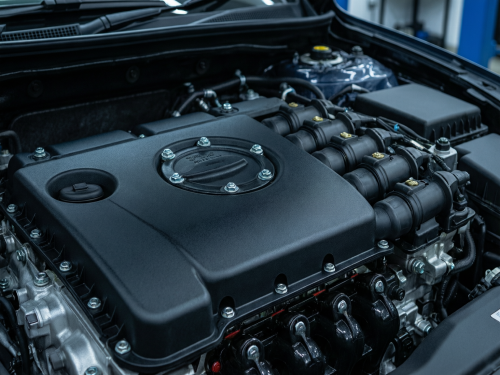
Valve cover PCV port design controls how crankcase gases are metered into the intake manifold, maintaining proper engine vacuum and emissions compliance. A well-integrated PCV port minimizes oil carryover while managing blowby volumes efficiently across the full engine operating range — idle vacuum of about -80 kPa gauge down to full-boost positive pressure of +150 kPa on turbocharged applications.
The PCV port is not just a hole in the valve cover. It's a calibrated flow-control point that must handle two competing requirements: it must pass enough gas to prevent crankcase pressure buildup, but not so much that it disturbs the intake manifold's fuel-air ratio or pulls oil past valve seals. Modern designs achieve this through careful port sizing (typically 6-12 mm internal diameter), inlet geometry (chamfered vs sharp-edged, straight vs angled), and integration with internal baffling that separates oil before gases exit.
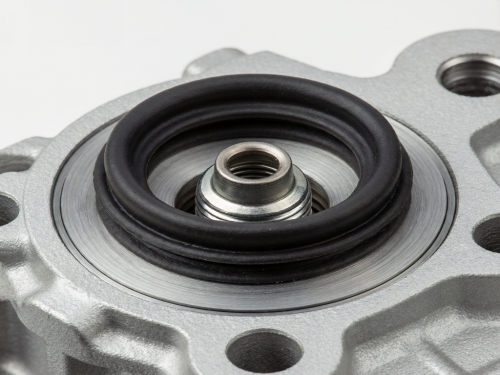
Three main topologies dominate. External PCV valve sockets — a molded boss that accepts a serviceable PCV valve — provide variable flow control through the PCV valve's spring-and-pintle mechanism, relying on external baffles or a simple internal deflector for oil separation. This is the classic design on older NA engines: many Toyota 2AZ-FE, Honda K24, and Nissan QR25DE units use it. Integrated fixed orifices — a calibrated hole drilled or molded into the cover with built-in labyrinth separation — deliver a specific flow curve without a serviceable valve, common on modern turbocharged applications like Ford EcoBoost 2.0/2.3 and Hyundai/Kia 1.6 T-GDI. Dual-port systems split regulated (idle/cruise) and unregulated (boost) flow into two separate paths with multi-stage oil separation, standard on high-output GDI turbo engines including many VW/Audi TSI applications and Mazda SkyActiv-T.
Comparing the three in prose: external PCV sockets are the most serviceable and easiest to diagnose (you can swap the valve to check flow), but they depend on internal baffling that isn't upgradeable. Fixed orifices are the least serviceable but the most consistent — no worn spring to change flow characteristics over time — and they generally deliver lower oil carryover. Dual-port systems handle the widest operating range but add complexity and cost; they're essentially mandatory on modern high-boost DI turbo engines because a single port cannot manage both -80 kPa idle vacuum and +150 kPa boost pressure without either drawing oil or venting to atmosphere.
A workshop misconception we hear often: "a PCV valve is a PCV valve." In reality, PCV valves are highly application-specific in their spring rate, pintle geometry, and flow curve. Installing a valve intended for a 2.4L NA engine into a 2.0L turbo engine — even if the fitting matches — will either restrict flow (causing crankcase pressure and oil leaks) or over-flow (causing lean idle and pulling oil past the seals). Always match to the specific OEM part number.
A case a technician relayed: a Ford EcoBoost 2.0 that developed a rough idle and misfire codes after an "upgrade" PCV valve was installed from a mail-order performance kit. The valve's spring was substantially weaker than the OEM part, drawing excessive vacuum on the crankcase and pulling oil past the intake valve seals. Codes cleared and idle stabilized within 20 km of installing the correct OEM PCV.
Nansen Auto holds valve cover patents covering PCV integration designs, developed after benchmarking OEM configurations across our vehicle coverage — Nissan, Toyota, Honda, Hyundai/Kia, VW/Audi, Ford, GM, Mazda, Mitsubishi, Suzuki, Great Wall, and Chrysler. Manufactured across our 10+ injection molding machines (130T-650T), each port undergoes 100% air tightness verification at 30 kPa and dimensional inspection to ±0.05 mm on the port ID and ±0.1 mm on the port axis angle relative to the flange. Our IATF 16949 first-article approval process includes flow-bench validation across the full operating range (idle vacuum through boost pressure) with an approved reference standard.
A subtle design consideration our engineering team learned the hard way: PCV port angle relative to the internal oil-splash zones matters. If the port opens directly into a stream of oil thrown off the camshafts, no baffle system fully compensates. Our patent covers a port-relocation geometry that positions the internal opening in a low-oil-splash zone and adds a directional shield above the port — a specific design detail replicated across the applicable models in our catalog.
A common industry pitfall: undersized aftermarket "catch cans" plumbed inline with the PCV path. Catch cans have legitimate uses on high-boost applications, but a can with an internal flow restriction increases crankcase pressure and defeats the PCV system's purpose. If a catch can is used, its flow area must equal or exceed the OEM PCV path throughout the entire pressure range.
We should be honest about one honest limitation: PCV ports and integrated baffles cannot fix underlying engine health issues. If blowby volumes are pathologically high due to ring wear, cylinder scoring, or head gasket failure, no port geometry keeps up. In those cases, the diagnostic finding is bottom-end wear, not a PCV problem — a distinction we sometimes have to explain to customers who assume a new valve cover will solve their oil consumption.
FAQ:
FAQ: Q: What does incorrect PCV port sizing cause? A: Undersized ports increase crankcase pressure and cause oil leaks from every seal. Oversized ports create excessive vacuum, pulling oil past valve seals and stem seals, and can cause lean idle codes on drive-by-wire engines.
FAQ: Q: Are PCV ports standardized across brands? A: No. Each OEM specifies unique port diameters, angles, and connection types (hose barb, quick-connect fitting, molded socket). Even within one brand, different engine families use different specifications.
FAQ: Q: Can I clean a clogged PCV port without removing the valve cover? A: Sometimes. If the external PCV valve is the source of the restriction, replacing the valve resolves it. If the internal orifice or baffle passages are clogged with sludge, valve cover removal — and often replacement — is required.
FAQ: Q: How often should the PCV system be inspected? A: On engines with 10,000+ km oil change intervals, inspect the PCV valve and check crankcase pressure at 60,000-80,000 km. On direct-injection turbo engines running short trips frequently, inspect at 40,000-60,000 km — the shorter interval reflects faster sludge accumulation from oil-vapor contact with cold surfaces.