 EN
EN

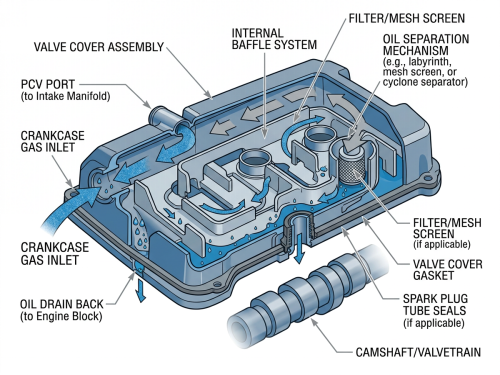
Valve cover baffle systems separate oil droplets from crankcase gases before they reach PCV ports, directly reducing oil consumption. Without effective baffles, oil mist enters the intake tract, causing burn-off in the combustion chamber, deposit buildup on intake valves (a particular headache on direct-injection engines like the Hyundai Theta II GDI and VW EA888), and progressive fouling of the catalytic converter. In our factory validation runs, we've seen poorly-baffled prototypes push oil carryover from a healthy 0.02 g/hr up to more than 0.15 g/hr under sustained load — enough to add nearly a liter of consumption between service intervals on a hard-driven fleet vehicle.
Baffles work by intercepting oil-laden gases via impingement surfaces. Crankcase pressure pushes gases upward, baffles capture droplets which drain back to the cylinder head through calibrated return holes (typically 2.5-4.0 mm on modern polymer covers), and clean gases exit through the PCV port. The physics is straightforward: oil droplets have far more inertia than the gas carrying them, so when the flow path is forced to change direction sharply, droplets impact the baffle wall and coalesce, while gas flows around them.
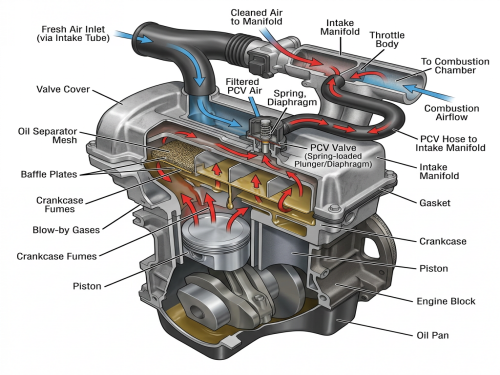
Design topology matters enormously. Flat plate baffles — essentially a stamped or molded shield above the cam area — achieve 70-80% oil separation and remain adequate on low-blowby naturally-aspirated engines such as older Toyota 2AZ-FE or Honda K24 units. Labyrinth or maze designs, which force gas through 3-5 successive chambers with 90-degree redirections, reach 85-92% and are the modern standard for turbocharged engines like the Ford EcoBoost 2.0 and the Hyundai/Kia 1.6 T-GDI. Cyclonic separators — using a tangentially-injected swirl chamber to spin droplets outward — deliver 90-97% efficiency and are increasingly specified for high-output GDI applications, VW/Audi 2.0 TFSI covers being a well-known example.
A common workshop misconception is that a valve cover leak automatically means a gasket problem. In reality, we see many cases where a technician replaces the gasket, torques everything perfectly, and the leak returns within weeks — because the real culprit was a cracked internal baffle causing crankcase over-pressurization that pushed oil past a perfectly healthy seal. A mechanic in one of our Nissan VQ35DE case studies traced repeated rear main seal seepage back to a hairline crack in the integrated baffle plate, invisible from the outside.
Comparing the three topologies in prose: a flat plate is cheap, easy to injection-mold, and adequate for blowby volumes under about 15 L/min. A labyrinth trades a small pressure drop (typically 0.5-1.5 kPa) for a big jump in separation efficiency and handles blowby up to about 30 L/min. Cyclonic designs demand tighter dimensional control (we hold ±0.15 mm on critical swirl chamber walls) and add 20-30% to tooling complexity, but they hold their efficiency even as blowby climbs past 40 L/min — which is where turbocharged engines live under boost.
Nansen Auto integrates application-specific baffle geometries across 150+ valve cover models, validated through air tightness testing at 30 kPa differential and high-temperature aging at 150°C for 1000 hours per IATF 16949 protocols. Our patented internal geometry — developed after benchmarking 40+ OEM designs across Nissan, Toyota, Honda, Hyundai/Kia, VW/Audi, and Ford platforms — combines a primary impingement wall with secondary labyrinth passages and a gravity-fed drain-back circuit that resists sloshing on cornering. Every production lot passes image inspection of the baffle geometry before assembly.
We should be honest about limitations: no baffle system fully eliminates oil carryover, and on high-mileage engines with worn piston rings, blowby volumes can exceed what any passive separator was designed to handle. In those cases, addressing ring wear is the real fix; a new valve cover only manages the symptom.
FAQ:
FAQ: Q: Can a damaged baffle increase oil consumption? A: Yes. A cracked or missing baffle allows oil mist into PCV lines, increasing consumption by 0.3-1.0 L per service interval on typical daily drivers, and considerably more on turbocharged applications running sustained boost.
FAQ: Q: Are baffles serviceable separately? A: In modern molded-polymer covers, baffles are ultrasonically welded or integrally molded and are not serviceable. Replacement requires the complete valve cover assembly. Some older cast-aluminum covers (certain BMW M-series, older GM LS variants) do allow baffle plate replacement with new fasteners and sealer.
FAQ: Q: How can I tell if my baffle is failing without removing the cover? A: Watch for three signs: rising oil consumption without visible external leaks, oily residue inside the intake manifold or throttle body, and a slight whistling or pressure buildup at the oil filler cap. A crankcase pressure test — typically 1-4 kPa on a healthy engine — will read high if the PCV path is clogged with oil-saturated debris.
FAQ: Q: Do I need a different baffle design if I add a turbocharger or run higher boost? A: Almost always yes. Factory NA baffles are calibrated for the stock blowby volume; forced-induction conversions can easily double or triple that. On modified applications we recommend upgrading to a labyrinth or cyclonic-equipped cover, or adding an external catch-can in series with the factory PCV path.