 EN
EN

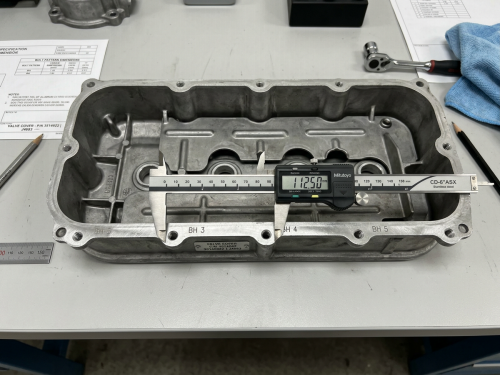
A valve cover bolt pattern defines the number, spacing, thread specification, and torque sequence of the fastening points that secure the cover to the cylinder head. Incorrect fitment causes uneven gasket compression, distorted sealing surfaces, and leaks that no amount of retorquing will cure — and in the worst cases, cracked cover flanges or stripped head threads that turn a $60 gasket job into a $600 repair.
Bolt pattern design is far more deliberate than it appears. OEM engineers position each fastener to balance the clamping load across the gasket bead, with tighter spacing in high-stress zones such as the corners and around the spark plug tubes. On a typical inline-4 valve cover, spacing runs 60-90 mm between adjacent bolts along the long sides and drops to 40-60 mm near the ends where thermal expansion is greatest. Deviation of more than ±0.15 mm in hole position begins to cause visible gasket bead compression irregularities under thermal cycling.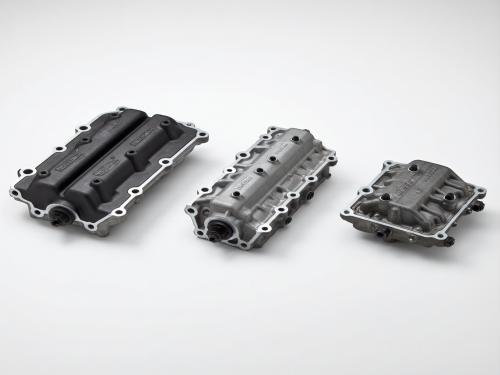
Inline-4 engines typically use 8-12 bolts with M6x1.0 threads torqued to 8-12 Nm — the Honda K-series K20/K24 uses 10 bolts at 10 Nm, while the Nissan MR20DE uses 12 bolts at 8 Nm in a cross-pattern sequence. V6 engines use 12-16 fasteners per bank at 9-13 Nm; the Nissan VQ35DE spec is M6x1.0 at 11 Nm following a spiral-out sequence from the center. V8 applications typically require 14-18 bolts per bank with M8x1.25 threads at 10-15 Nm, with GM LS-series covers being a familiar example. Torque sequence matters as much as final torque value — starting from the center and spiraling outward keeps the gasket bead from being trapped or pinched.
In our production, Nansen Auto maintains bolt-pattern accuracy across covers for Nissan, Hyundai/Kia, Toyota, Honda, and VW/Audi by using automated image-testing systems that verify hole position within ±0.1 mm and hole roundness within 0.05 mm during 100% inspection of every part off the injection molding line. Every cavity of every mold — spanning our 10+ machines from 130T to 650T — is digitally referenced against the OEM master drawing under IATF 16949 first-article approval.
A common workshop pitfall we hear from mechanics is over-torquing polymer covers in an attempt to "just stop the leak." This almost always backfires. Modern glass-fiber-reinforced polyamide (PA66-GF35 is a typical grade) has a compressive yield around 90-110 MPa at room temperature but drops to roughly 40-50 MPa at 150°C engine bay temperatures. Applying 20 Nm to a bolt spec'd for 10 Nm — a common mistake we see when a technician switches from ft-lb to Nm without converting — will crush the bolt boss, warp the flange, and turn a solvable seal problem into a mandatory cover replacement.
Another subtle issue: torque-to-yield (TTY) bolts. Some newer engines, notably certain Hyundai Theta II and VW EA888 applications, specify TTY bolts for their valve covers. These are designed to elongate plastically during initial installation, delivering very consistent clamping force — but they must never be reused. In our factory testing, reused TTY bolts show 25-40% variability in final clamping load versus 3-5% for fresh bolts, which directly correlates to gasket leak rate.
Comparing OEM vs aftermarket in prose form: IATF 16949-certified aftermarket manufacturers replicate OEM hole spacing, thread specification, and boss geometry within OEM print tolerance. Non-certified suppliers frequently deviate — we've measured aftermarket covers with hole positions off by 0.3-0.8 mm, resulting in cross-threading during installation and premature gasket failure at 5,000-10,000 km rather than the OEM design life of 150,000 km+.
A seasoned mechanic anecdote from a shop we supply: they had a batch of Ford 2.0 EcoBoost covers from an unnamed source where the eight bolt holes were arranged in a slightly compressed pattern — visually identical, but off by about 0.4 mm cumulative across the flange. The tech spent 90 minutes trying to figure out why the cover "just wouldn't sit flush" before switching to a certified part that dropped into place in under two minutes.
We should be honest about one aftermarket reality: even certified parts occasionally have minor cosmetic differences from OEM — logo placement, breather nipple angle, sensor boss finish — that do not affect fitment or function. What matters is the mating geometry, and that is what our image-testing and CMM protocols protect.
FAQ:
FAQ: Q: Can reusing stretched bolts cause leaks? A: Yes. Torque-to-yield bolts elongate permanently during first installation and lose 25-40% of their clamping consistency on reuse. Standard non-TTY M6 bolts can be reused 2-3 times if inspected for straightness and undamaged threads.
FAQ: Q: Do aftermarket covers always match OEM bolt patterns? A: Not always. IATF 16949-certified manufacturers replicate OEM dimensions within ±0.1 mm, but uncertified sources may deviate by 0.3 mm or more, causing installation and sealing problems.
FAQ: Q: What's the correct tightening sequence for a valve cover? A: Start from the center bolts and work outward in a spiral or cross pattern in two or three passes — typically 30%, 60%, and 100% of final torque. This distributes the gasket compression evenly and avoids trapping the seal bead.
FAQ: Q: How do I know if my bolt threads in the head are damaged? A: A properly-clean thread should accept the bolt fully by hand with no resistance until the head contacts the boss. If you feel binding, or the torque wrench clicks at a value well below spec (usually because the bolt bottoms out or strips), the head threads may need a thread insert such as a Time-Sert or Heli-Coil repair.