 EN
EN

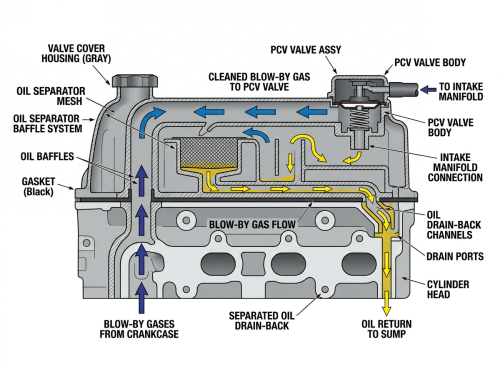
A valve cover breather system vents excess crankcase pressure while preventing oil from escaping the engine. It maintains a slight vacuum (typically -2 to -8 kPa at idle) inside the crankcase, which reduces oil leaks past every seal in the engine — front and rear mains, cam seals, oil pan gasket — and improves ring sealing efficiency by minimizing the pressure differential the rings must fight against during the compression stroke.
Blowby gases collect in the crankcase during combustion as some fraction of cylinder pressure escapes past the piston rings. On a healthy modern engine this is roughly 15-25 L/min under load; on a worn engine it can climb past 60 L/min. These gases route upward through oil drain-back passages in the cylinder head, into the valve cover cavity, and exit through the breather port. Along the way, oil separators — typically the same baffle systems that manage oil carryover to PCV — capture liquid droplets before gases exit.
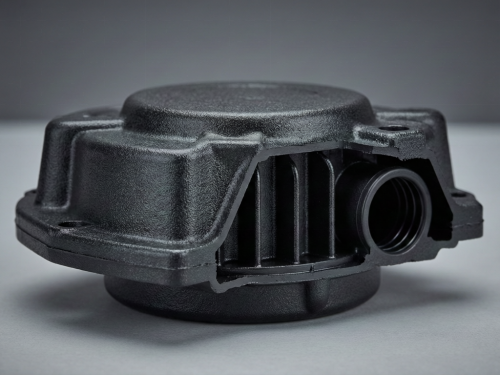
There are three main breather architectures. Open mesh filter designs — think classic 1960s-70s American V8s with a chrome breather cap — provide passive atmospheric venting with moderate oil-carryover risk and no vacuum regulation. They're now largely obsolete on production vehicles due to emissions regulations, though they still appear on racing and specialty applications. PCV-integrated ports, the modern default across Toyota, Honda, Hyundai/Kia, Ford, GM, VW/Audi, offer regulated vacuum drawn from the intake manifold with low oil carryover risk when properly baffled. Heated breather tubes — commonly specified on Great Wall and other cold-climate market vehicles, and on many European vehicles for the Nordic and Russian markets — add a resistive heating element (typically 40-60 W at 12V) to prevent condensate freezing in the tube, which would otherwise cause a dangerous crankcase pressure buildup below about -20°C.
In comparison prose: the open mesh design has essentially zero pressure regulation and is unsuitable for modern emissions-compliant vehicles. The PCV-integrated design regulates crankcase pressure to a narrow band via the PCV valve's spring-loaded pintle, which restricts flow at high manifold vacuum (idle) and opens progressively as vacuum drops (WOT). The heated tube design adds no separation capability by itself — it must be combined with a labyrinth or cyclonic baffle — but it's essential wherever ambient temperatures fall below -15°C for extended periods.
A real-world case a Hyundai/Kia specialist shared with our engineering team: a Theta II 2.4L that developed an intermittent "oil pushing past the dipstick" complaint during a Michigan winter. The cause turned out to be ice plugging the breather-to-intake hose at the halfway point, where hot crankcase vapor met the cold outer air through the plastic hose wall. A heated breather retrofit — plus a PCV service — resolved it permanently.
Nansen Auto engineers breather integration into valve covers for 80+ countries' climatic conditions, from Middle Eastern desert heat validation (soak testing at 85°C ambient for 240 hours) to Nordic cold-start scenarios (-40°C thermal shock). Every breather-integrated cover passes salt spray testing per ASTM B117 for 480+ hours and vibration testing per SAE J1455 at our 26,666 sqm Si County, Anhui facility. We hold IATF 16949 certification for the full manufacturing process, and our breather port geometries are dimensionally verified via CMM before mold release.
A common industry misconception worth clearing up: a "whistling" oil filler cap does not always mean the PCV valve is bad. It often indicates a partially clogged breather passage in the valve cover baffle itself — sometimes the drain-back holes have been narrowed by oil sludge deposits, especially on engines with extended oil change intervals or persistent short-trip driving. In these cases, simply replacing the PCV valve fixes the symptom for a week or two, then the noise returns. The correct fix is inspection of the internal baffles, which typically means valve cover replacement.
Turbocharged engines deserve special mention. Under boost, intake manifold pressure goes positive (up to 1-2.5 bar absolute on modern GDI turbos like the Ford EcoBoost 2.3 or Hyundai 1.6 T-GDI), which reverses the PCV valve flow direction. Modern designs handle this via dual-path breathers: PCV flow into the manifold at cruise/idle, and reverse flow into the pre-turbo air path under boost. If the reverse-flow separator is missing or damaged, oil is pushed into the intercooler and intake tract — a classic source of "turbo blue smoke" complaints that gets mis-diagnosed as turbo seal failure.
We should be honest about limits: no breather system compensates indefinitely for excessive blowby caused by worn rings or cylinder scoring. If measured crankcase pressure is above 8 kPa at idle on a warm engine, the breather isn't the problem — the bottom end is.
FAQ:
FAQ: Q: What happens if the breather clogs? A: Crankcase pressure rises above the design range, pushing oil past every seal in the engine. White smoke from the dipstick tube, oil sprayed under the hood, and blown front/rear main seals within weeks are all common symptoms.
FAQ: Q: Do turbocharged engines need different breathers? A: Yes. Turbo engines generate higher blowby volumes under boost and require PCV-integrated or cyclonic designs with a dual-path breather that manages both vacuum (cruise) and positive-pressure (boost) flow regimes.
FAQ: Q: Can I run an engine with no PCV/breather system at all? A: Only briefly and never legally on an emissions-controlled vehicle. Even mechanically, disconnecting the breather causes rapid crankcase pressure buildup, oil seepage from every seal, and in extreme cases can pop the dipstick out entirely under load.
FAQ: Q: How often should the breather passages be inspected? A: On engines with extended oil change intervals (10,000 km+) or heavy short-trip use, we recommend inspecting the PCV valve and breather nipple every 40,000-60,000 km. Sludge buildup accelerates once the internal drain holes narrow past about 60% of original diameter.