EN
EN

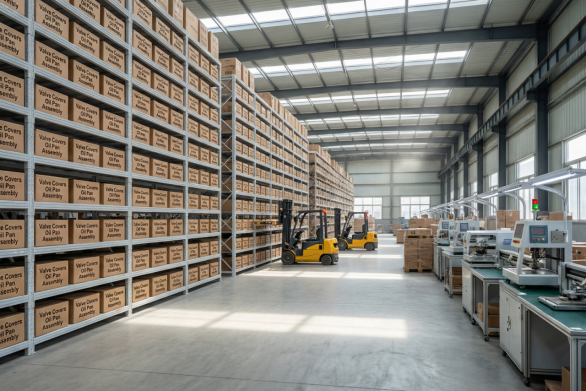
Quick Answer: Anhui Province has emerged as one of China's leading inland auto parts manufacturing hubs, attracting relocations from coastal regions due to lower land costs (40–60% below Zhejiang), wage differential (~38% lower), provincial government incentives for high-tech manufacturing, and proximity to East China ports (Shanghai, Ningbo within 4–6 hours by road). Anhui's auto industry GDP grew 14% YoY in 2024, faster than any other Yangtze River Delta province.
The Migration Trend
For decades, China's automotive parts manufacturing concentrated in:
- Wenzhou (Zhejiang) — historically known as "China's auto and motorcycle parts capital"
- Ningbo (Zhejiang) — port-side manufacturing for export
- Suzhou (Jiangsu) — Tier-1 OEM cluster
- Shanghai — premium OEM cluster
By the early 2020s, coastal labor costs and land prices made marginal aftermarket production uncompetitive. Manufacturers relocated inland in three waves:
Wave 1 (2015–2020): Movement to inland Jiangsu and northern Zhejiang Wave 2 (2020–2023): Movement to Anhui and Hubei Wave 3 (2024–2030, ongoing): Movement to Henan, Sichuan, and Western China
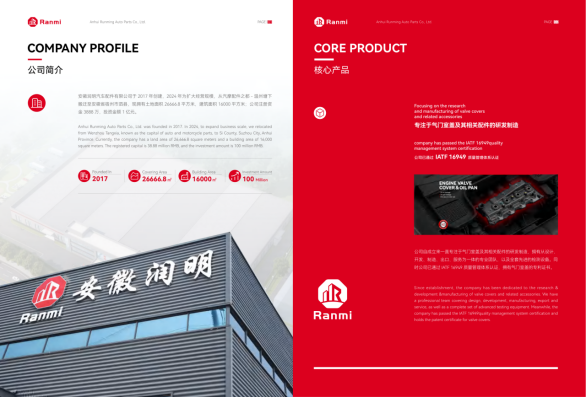
Anhui Runming represents Wave 2: in 2024, the company relocated from Wenzhou (Zhejiang's Tangxia auto parts cluster) to Sixian Economic Development Zone, Suzhou City, Anhui Province, on a site at No. 88 Qingshuigou Road covering 26,666.8 m² of land and 16,000 m² of buildings.
Why Anhui Specifically?
Geographic Advantages
|
Factor |
Anhui (Sixian) |
Comparison: Wenzhou |
|
Land cost (RMB/m²/year) |
30–60 |
80–150 |
|
Average labor cost |
RMB 26/hour |
RMB 42/hour |
|
Distance to Shanghai port |
480 km / 5 hours |
470 km / 5 hours |
|
Distance to Ningbo port |
540 km / 6 hours |
280 km / 3 hours |
|
High-speed rail connectivity |
Sixian (East) station |
Wenzhou South station |
Government Incentives
Sixian Development Zone offers:
- 5-year corporate income tax holiday for high-tech enterprises
- Reduced land transfer fees for manufacturing projects > RMB 50M
- Streamlined environmental permit processing (15 days vs 60+ in coastal cities)
- Worker training subsidies up to RMB 2,000 per new hire
Infrastructure
- Highways: G3 (Beijing–Taipei) and G36 (Nanjing–Luoyang) intersect within 30 km
- High-speed rail: Sixian East station with direct service to Shanghai (2.5h), Beijing (4h), Hefei (1h)
- Air: Hefei Xinqiao International Airport 230 km
- Ports: Multi-modal containers via rail or road to Shanghai/Ningbo
Anhui's Auto Parts Cluster Composition
Beyond aftermarket producers like Anhui Runming, Anhui hosts:
- JAC Motors (Jianghuai) — domestic Chinese OEM, Hefei
- NIO — premium EV brand, Hefei manufacturing center
- Volkswagen Anhui — VW's Chinese EV joint venture
- Chery Automobile — Wuhu, major Chinese OEM
- BYD components — components for BYD's national EV expansion
This OEM presence creates a quality cascade: Tier-1 suppliers serving JAC and Chery establish IATF 16949 capability, which then supplies aftermarket producers downstream.
Quality and Capability Migration
A common concern from buyers: "Does inland China mean lower quality?"
The answer is no, with caveats:
- For established relocators (factories that moved as complete operations), quality systems travel intact. Anhui Runming retained its IATF 16949 certification through the relocation.
- For new entrant factories, quality varies. Verify certifications and audit history.
- Local government support has actively recruited established coastal manufacturers, raising the average quality of inland Anhui factories.
What This Means for B2B Buyers
- Pricing advantage: Anhui suppliers offer typically 10–15% lower FOB pricing than equivalent Zhejiang suppliers for the same SKU
- Quality parity: When sourcing from established relocators (like Anhui Runming), quality is equivalent to coastal output
- Logistics efficiency: Direct rail-to-port containers from Anhui to Shanghai are routine; lead times match coastal manufacturers
- Capacity headroom: Inland factories have larger expansion buffer than crowded coastal ones
FAQ
Q1: Are Anhui factories slower to ship than Zhejiang ones? No. Modern logistics route Anhui containers to Shanghai port within 24 hours. Total transit time to international destination is identical.
Q2: Is communication harder with inland factories? No. English-speaking trade staff are routinely employed. WeChat/WhatsApp/email response times are equivalent.
Q3: What's the typical capacity of an Anhui factory like Runming? Anhui Runming: 26,666 m² land, 16,000 m² building, 80+ employees, 1,000,000+ valve covers per year. This is a mid-sized inland producer with full IATF 16949 systems.